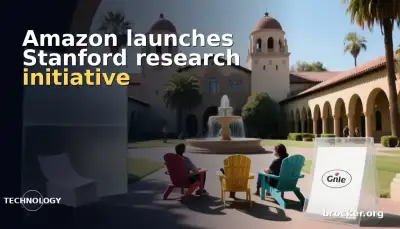
Amazon and Stanford University launched the Stanford and Amazon Research Initiative on September 21, 2026 — a named framework for joint work at the frontiers of artificial intelligence, energy, and healthcare. The announcement formalizes a relationship in which more than 10 Amazon teams already fund Stanford research and PhD fellowships.
What happened
The new initiative covers foundational and applied AI, machine learning, automated reasoning, health, energy, and chips. Under the framework, Stanford faculty and Amazon scientists will run joint research projects, Amazon will support PhD fellowships aimed at key technical challenges, and both sides will host symposia and workshops for interdisciplinary scholars.
The launch followed a September 16 campus event that brought together AWS CEO Matt Garman, Stanford Vice Provost and Dean of Research David Studdert, and Professor Curtis Langlotz for a fireside chat on university–industry collaboration. AWS VP and Distinguished Engineer Nafea Bshara and Studdert framed the initiative as a way to accelerate breakthroughs into real-world solutions and deepen the existing partnership.
Context
Amazon’s Stanford footprint was already broad but fragmented: existing efforts span humanoid robotics, post-quantum cryptography, causal measurement science, and AI-driven radiology. The initiative is meant to give that work a single structure rather than a set of separate arrangements. Amazon Science’s announcement does not disclose total funding, fellowship headcount, first-cohort projects, IP terms, or a timeline for the first symposium under the new brand.
Our take
Naming a long-running set of Amazon–Stanford grants as one initiative is an organizational signal, not a product or capability claim. Until budget, IP terms, and first projects surface, treat this as a branded wrapper around existing spend — useful for coordination, not proof of a new research pipeline.