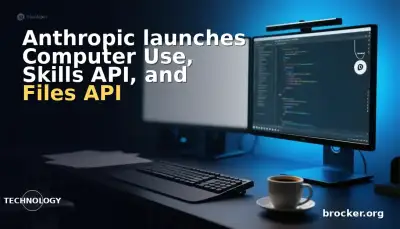
Anthropic made Computer Use, the Skills API, and the Files API generally available on the Claude Platform on August 20, 2026, and added a new Browser Use tool that lets agents interact with web applications by targeting page structure instead of screen coordinates. The release moves the company's agent stack from beta into production readiness for enterprise workloads.
Computer Use now executes multiple actions per model turn rather than a single click or keystroke per call, reducing the round trips needed for multi-step tasks. The capability is also covered under Anthropic's Business Associate Agreement, making it eligible for HIPAA-regulated workloads in healthcare and insurance. Browser Use extends the same multi-action model to the web, reading DOM structure to locate fields and buttons more reliably than pixel-based automation alone.
What's new
- Computer Use: Multi-action turns, HIPAA eligibility under BAA.
- Browser Use: New tool within Computer Use that operates on page structure for web apps.
- Skills API: Simplified upload and versioning of reusable skill folders (instructions, scripts, templates) that run in Claude's code execution sandbox.
- Files API: Automatic file expiration, 5x higher rate limits, and 1 TB of storage per organization.
The Skills API lets teams package operating procedures — such as a bank's credit methodology or an insurer's filing workflow — as versioned assets that agents load only when a task calls for them. The Files API stores source documents and generated deliverables so large inputs don't need to be re-sent on every request. Together with pre-existing code execution and web search, the four capabilities form a loop: the model interprets a goal, selects a skill, acts via Computer Use or Browser Use, reads and writes files, and returns a finished artifact.
Early adopters reported measurable gains. A research engineer at a claims-automation company said their longest workflow dropped from 32 minutes to 13 minutes, cost per task fell roughly 30% across tested workflows, and completion reached 100% without prompt changes. A banking product lead described using a skill to encode a firm's credit methodology and memo format, letting an agent produce source-grounded credit memos for analyst review without building each workflow from scratch.
Why it matters
The release addresses three failure modes that have stalled early agent projects: undocumented processes that live only in tribal knowledge, agents that produce chat transcripts instead of usable deliverables, and the lack of a governed way to reuse large inputs across runs. By versioning skills, storing files with IDs, and adding approval gates before irreversible actions, the stack gives enterprises a path from prototype to auditable production deployment.
Availability extends beyond Anthropic's own platform: the Skills API and Files API are also live on Microsoft Azure AI Foundry, and the updated Computer Use and Browser Use tools are slated for Google Cloud Vertex AI. Existing beta integrations continue to work during migration.
Our take
The multi-action turn is the quiet architectural shift here. Reducing round trips changes the economics of long-horizon tasks more than any single benchmark score, and the BAA coverage signals that Anthropic expects regulated enterprises to run these workloads at scale — not just experiment.