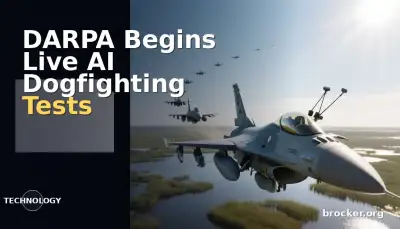
DARPA and the U.S. Air Force have started a new flight-test campaign that puts artificial intelligence agents in modified F-16s under the same sensor, weapon, and communication constraints as human pilots. The first autonomous sortie under the Artificial Intelligence Reinforcements (AIR) program flew earlier this month at Eglin Air Force Base in Florida, the agencies announced July 16.
A test pilot took off in an F-16 equipped with the Viper Experimentation and Next-generation Operations Model (VENOM) autonomy kit, handed control to the onboard AI, then retook control to land. The VENOM kit automates flight controls and sensors without altering the jet's core software, letting a pilot toggle between human and AI control with a switch.
What's new
- Program: DARPA AIR (Artificial Intelligence Reinforcements), building on the earlier Air Combat Evolution (ACE) effort.
- Platform: Six F-16s modified with the VENOM Autonomy Kit (VAK) at Eglin AFB.
- Key difference from ACE: Previous ACE flights used the one-off X-62A VISTA testbed with "perfect" simulated data. VENOM jets use live sensors, real weapons flyout models, and the same dynamics as operational fleet F-16s.
- Investment: Over $132 million in AIR; roughly three years developing VENOM while training AI agents through thousands of simulation hours.
- Contractors: DARPA declined to name the firms that developed the AI agents.
Brig. Gen. James "Fangs" Valpiani, the outgoing DARPA program manager, said the shift to operationally representative aircraft is a "sea change" because earlier work always relied on a "white card" — simulation standing in for the real human experience. Lt. Col. Patrick "Dice" Highland, Ph.D., takes over as AIR program manager this month. Terry Wilson, Ph.D., director of AI Development and Transition for AFRL's Autonomy Capability Team (ACT3), remains deputy program manager for both VENOM and AIR.
Why it matters
The campaign is designed to prove AI agents can handle the uncertainty, deception, and sensor degradation that human pilots routinely face. The test plan mirrors human pilot training: start with basic fighter maneuvers (dogfighting), progress to one-versus-one engagements at increasing distances — first within visual range, then beyond visual range — then add wingmen for two-versus-two and eventually four-versus-four scenarios. Valpiani noted four-versus-four proficiency takes new human pilots one to two years. Later phases will introduce electronic warfare and simulated weapons. Successful agents are slated to transition to the Air Force's Collaborative Combat Aircraft (CCA) program, which aims to field autonomous drones that operate alongside crewed fighters.
Our take
Moving from the unique X-62A VISTA to a fleet of standard F-16s with a non-invasive autonomy kit is the real engineering story here. It turns AI development from a bespoke testbed exercise into something that can scale across the existing inventory — if the agents can actually cope with noisy, incomplete live sensor data in multi-ship fights. The two-year timeline Valpiani cited for four-versus-four proficiency is a useful benchmark; watch whether AI agents close that gap or hit a wall on coordination and deconfliction.
Sources
- Aerospace America: New test campaign will put AI pilots in most realistic flight conditions yet, DARPA official says
- DARPA: DARPA, U.S. Air Force fly AI-controlled F-16
- DefenseScoop: Pentagon takes AI dogfighting to next level in real-world flight tests against human F-16 pilot
- Stars and Stripes: F-16 outfitted with AI kit completes pathbreaking sortie in 'monumental milestone'
- YouTube: DARPA VENOM F-16 autonomous flight test footage