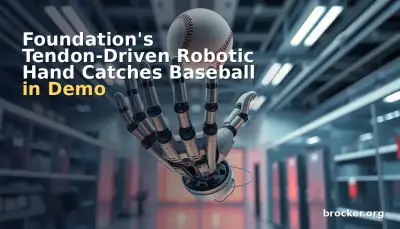
Foundation, a U.S.-based robotics company, has demonstrated a tendon-driven robotic hand capable of catching a baseball mid-air. The demo showcases a biomimetic design that combines precise timing with predictive control to repeatedly intercept fast-moving objects using what the company describes as a simplified hardware architecture. The achievement highlights progress in dexterous manipulation, a longstanding bottleneck in robotics that has limited real-world deployment of humanoid and mobile manipulators.
The demonstration, shared via social media and covered by Interesting Engineering, shows the hand — referred to in related technical materials as the Faive Hand — tracking and closing around a baseball thrown at speed. Unlike conventional motor-per-joint designs, the system uses tendon-driven rolling contact joints that route actuation through cables, reducing weight and complexity at the fingers while moving the bulk of the actuators to the forearm or base. This approach mirrors human anatomy, where tendons transmit force from muscles in the forearm to the fingers.
What's New / Specs
The Faive Hand's architecture centers on tendon-driven rolling contact joints, a design choice that eliminates the need for heavy motors at each finger joint. Instead, actuators are centralized, and force is transmitted through high-strength tendons routed through low-friction pathways. This yields a high strength-to-weight ratio at the end effector, allowing faster acceleration and lower inertia — critical for intercepting a moving baseball. The hand's degrees of freedom are not explicitly listed in the demo materials, but the biomimetic layout suggests at least four fingers plus a thumb with multiple joints each, consistent with anthropomorphic manipulation research targets.
- Actuation: Tendon-driven, centralized actuators with rolling contact joints
- Control: Predictive timing combined with real-time visual or proprioceptive feedback
- Demo task: Repeated mid-air catches of a thrown baseball
- Hardware philosophy: Simplified finger design, complexity shifted to control and tendon routing
- Related technical name: Faive Hand (per YouTube technical overview)
The Instagram post accompanying the demo emphasizes that the system achieves repeated catches through "precise timing with predictive control" rather than brute-force speed alone. This implies a perception pipeline — likely high-speed vision or event-based cameras — that estimates trajectory early, feeds a motion planner, and triggers the hand's closure at the calculated intercept point. The "simplified hardware design" claim suggests the team has reduced part count, assembly complexity, or both, which would improve reliability and lower cost if the platform moves toward production.
For context, a separate but related development from 1X (formerly Halodi Robotics) was noted in the same news cycle: their new hands feature 25 degrees of freedom, tendon-driven design, and force sensing on every joint. While Foundation's demo focuses on a high-speed catching task, 1X's specification sheet targets general-purpose manipulation with dense tactile feedback. The convergence on tendon-driven architectures across multiple well-funded teams signals a broader industry shift away from direct-drive or gear-heavy finger designs.
Why It Matters
Dexterous manipulation remains the primary barrier to useful general-purpose robots in unstructured environments. Industrial grippers excel at repeatable pick-and-place but fail at variable geometry, slip detection, or in-hand reorientation. A tendon-driven hand that can catch a baseball demonstrates several capabilities at once: low-latency perception-to-action loop, dynamic force control at impact, and compliance that absorbs energy without damaging the object or the hand. These traits transfer directly to tasks like catching falling tools, receiving handed objects from humans, or intercepting debris in cluttered spaces.
The centralized actuation model also addresses a practical scaling problem. Motor-per-joint hands accumulate mass distally, increasing inertia and requiring larger proximal actuators to move the fingers themselves — a vicious cycle. By routing tendons, Foundation's design keeps the hand light, which reduces the payload burden on the robot arm and improves whole-body dynamic performance. If the tendon routing proves durable over millions of cycles, the maintenance advantage over gearboxes (which wear, backlash, and require lubrication) could be significant for commercial deployments.
From a competitive standpoint, the demo arrives as humanoid robotics attracts massive investment. Figure, Apptronik, Agility, Tesla, and 1X are all iterating on hand designs. Foundation's public demonstration of a dynamic catching task — rather than static grasping — differentiates its approach by emphasizing speed and predictive control. Whether the hand integrates with a specific humanoid platform or is offered as a modular end effector remains unclear, but the technical direction aligns with the needs of any mobile manipulator that must operate at human-like speeds.
Our Take
Foundation's baseball catch is a compelling proof point for tendon-driven manipulation, but the path from lab demo to reliable product involves several unresolved questions. Tendon systems introduce compliance that complicates precise position control; hysteresis, stretch, and routing friction must be modeled and compensated in real time. The demo shows success at a specific task — catching a known object on a known trajectory — but generalization to unknown objects, variable masses, and off-center impacts will require richer tactile sensing and adaptive control policies. The absence of reported force sensing on the Foundation hand (unlike 1X's 25-DOF design with per-joint force sensors) may limit closed-loop slip detection and gentle manipulation.
Durability is another open variable. Tendons fatigue, pulleys wear, and routing paths can bind under contamination or temperature cycling. A lab demo does not reveal mean-time-between-failure data. If Foundation targets commercial deployment, they will need to publish cycle-life testing and serviceability metrics. The "simplified hardware" claim is promising, but simplicity in part count does not guarantee simplicity in calibration or field repair.
On the control side, the predictive timing approach is sound for dynamic interception, but it demands a perception system with low latency and high update rate. Event-based cameras or high-frame-rate global-shutter imagers add cost and integration complexity. The overall system cost — hand plus perception plus compute — will determine whether this architecture wins in price-sensitive markets like logistics, or remains confined to high-value research and defense applications. For now, the demo is a strong technical signal; the commercial signal will come when Foundation publishes specs, pricing, and integration documentation for partners.
FAQ
What is the Faive Hand and how does it differ from conventional robotic hands?
The Faive Hand is Foundation's biomimetic tendon-driven robotic hand that uses rolling contact joints and centralized actuation. Unlike conventional hands that place a motor at each joint, the Faive Hand routes force through tendons from actuators located in the forearm or base, reducing finger weight and inertia while mimicking human anatomy.
How does the hand catch a baseball mid-air?
The system combines high-speed perception (likely event-based or high-frame-rate vision) with predictive control to estimate the ball's trajectory early, plan an intercept point, and trigger finger closure at the precise moment. The tendon-driven design provides the low inertia and compliance needed to absorb impact energy without damaging the hand or the ball.
What are the advantages of tendon-driven actuation for robotic hands?
Tendon-driven actuation centralizes mass, lowers distal inertia, enables higher finger speeds, and reduces the number of components in the fingers themselves. This improves dynamic performance, simplifies finger mechanics, and can increase durability by eliminating gearboxes at each joint — though tendon wear and routing friction introduce their own maintenance considerations.
Does the Foundation hand include force or tactile sensing?
The demo materials do not mention integrated force or tactile sensing on the Foundation hand. This contrasts with 1X's recently announced 25-DOF hand, which includes force sensing on every joint. The absence of reported tactile feedback may limit the hand's ability to detect slip, regulate grip force gently, or perform delicate in-hand manipulation without visual confirmation.
When might this hand be available for commercial deployment?
Foundation has not announced a commercial release timeline, pricing, or integration partners. The baseball catch demonstrates a research-grade capability; transitioning to a product requires cycle-life validation, environmental sealing, calibration procedures, and software interfaces for third-party arms. Interested parties should monitor Foundation's official channels for technical specifications and partnership announcements.
Sources
- Interesting Engineering: Foundation's tendon-driven robotic hand nails baseball catch in demo
- Instagram post: Foundation robotic hand baseball catch demo
- YouTube: Getting the Ball Rolling: Learning a Dexterous Policy for a Biomimetic Tendon-Driven Hand (Faive Hand)
- Instagram reel: Advanced tendon-based robotic hand demonstration