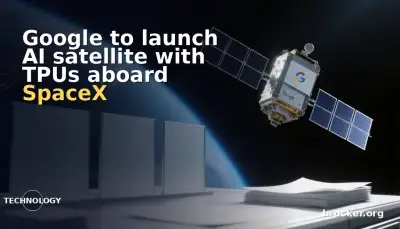
Google will send a satellite equipped with its Tensor Processing Units into orbit on October 1. The payload will ride aboard a SpaceX Falcon 9 rocket. This is the first flight test for Project Suncatcher, the company's experimental program to evaluate whether AI compute can scale in space.
The mission is designed to measure how Google's custom AI chips handle the physical stress of launch, orbital radiation, and thermal extremes in low Earth orbit. Project Suncatcher aims to eventually deploy a constellation of chip-equipped satellites as an alternative to ground-based data centers. The idea has also been floated by Elon Musk, Jeff Bezos, and former Google CEO Eric Schmidt.
The company intends to place two satellites in orbit the following year. This initial mission will be used to identify failure points and validate cooling approaches that include heat pipes and radiators. According to senior director Travis Beals, the chips can run for approximately 15 minutes before requiring a cooldown.
Confirmed
- Launch: October 1, 2026, aboard a SpaceX Falcon 9
- Payload: Satellite carrying Google Tensor Processing Units (TPUs)
- Program: Project Suncatcher, Google's experimental orbital AI compute initiative
- Mission goal: Test TPU resilience to g-force, radiation, and thermal cycling in low Earth orbit; evaluate heat pipe and radiator cooling
- Constraint and next step: Chips run ~15 minutes before cooldown (per senior director Travis Beals); two more satellites planned for next year
Unknown
- Which TPU generation is on board; the announcement does not name it.
- Whether the heat pipe and radiator setup extends the roughly 15-minute run time, and by how much.
- Launch timing and design details for the two satellites planned for next year.
Our take
This is a hardware test, not a service launch. The most telling figure is the one Google volunteered: the chips run about 15 minutes before they must cool down. That duty cycle, not launch logistics, is what stands between Project Suncatcher and orbital compute that could stand in for data centers on Earth. The cooling results from this flight will say more about the idea's future than the launch itself.