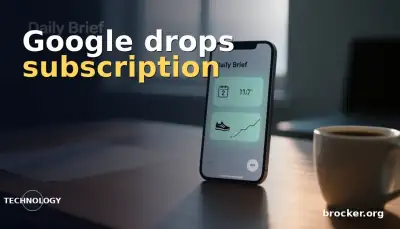
Google has removed the paid-subscription requirement for Gemini Daily Brief, making the AI-powered morning digest available to free personal accounts in the United States. The feature, introduced at I/O 2026, scans Gmail, Google Calendar, connected apps, and past Gemini chats to produce a prioritized daily rundown with suggested next steps.
The rollout is gradual and limited to users aged 18 or older with a personal Google account. Access still requires enabling Personal Intelligence, Memory, and Google Workspace integration in Gemini settings. Work, school, and supervised accounts are not eligible, and the feature remains English-only for now.
Confirmed
- Daily Brief no longer requires a Google AI Plus, Pro, or Ultra subscription, according to Google's updated support page and an official X post from the Gemini App account.
- The feature is available in the Gemini mobile apps (Android and iOS), on the web at gemini.google.com, and via Gemini Live voice interaction.
- Two main sections compose each brief: "Top of mind" for timely, actionable items drawn from Gmail, Calendar, and Gemini chats; and "Looking ahead" for longer-term goal suggestions powered by Personal Intelligence.
- Users can chat about items, mark them complete or dismiss them, and give helpful/not-helpful feedback to refine future briefs.
- Availability: U.S. only, English only, 18+, personal Google accounts only, gradual rollout.
Unknown
- No timeline for expansion beyond the United States or support for additional languages.
- No independent benchmarks on summarization accuracy, hallucination rates, or latency for the free tier versus the previous paid tier.
- Google has not disclosed whether free-tier users face any rate limits, reduced data-source depth, or lower priority in the rollout queue.
- Planned audio Daily Briefs and Android lock-screen integration (spotted in APK teardowns) remain unconfirmed for launch dates.
Our take
Removing the paywall turns Daily Brief into a distribution lever for Google's Personal Intelligence platform: the more users opt in to cross-app data access, the richer the training signal for proactive agents. The real product question is whether the free tier sustains the same retrieval depth and action quality as the paid version — something only longitudinal user reports will reveal.