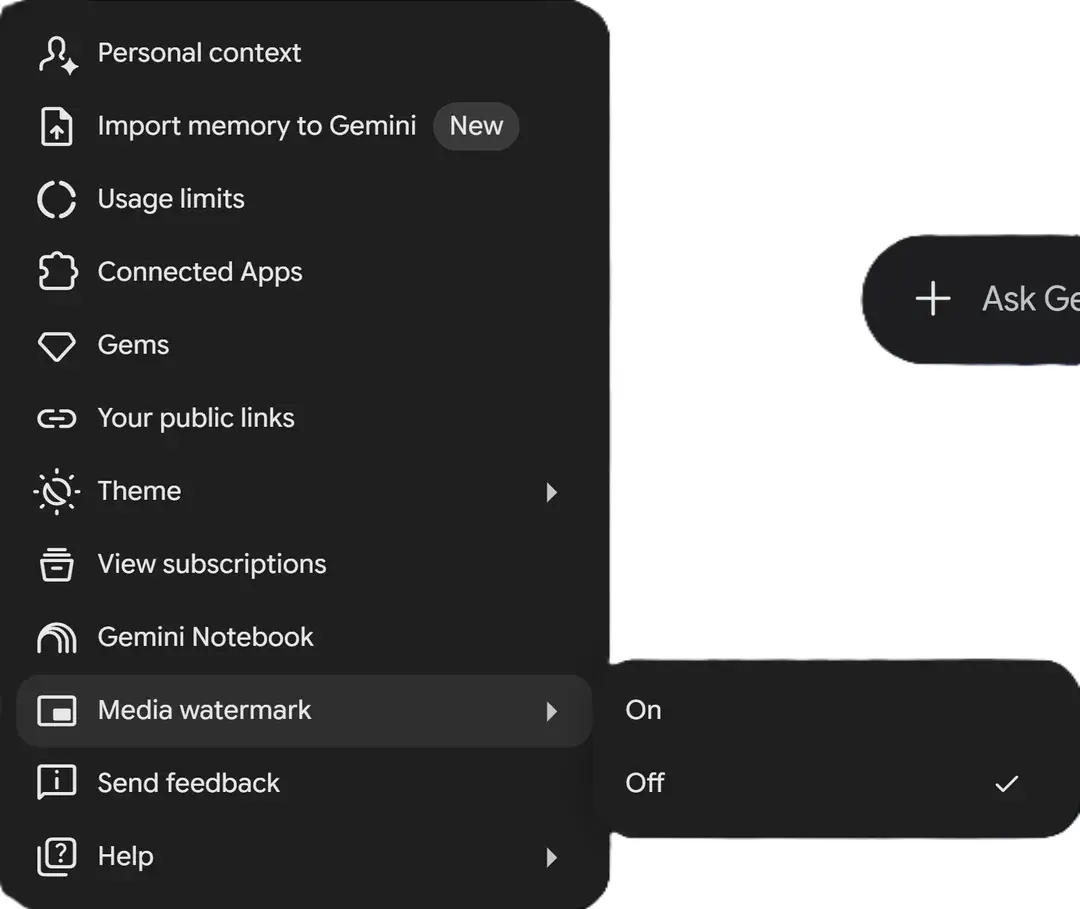
Google announced on Friday that Gemini users can now turn off the visible watermark applied to AI-generated images, videos, and music created in Gemini Apps. The change rolls out in the coming days and adds a Media Watermark toggle under Settings that lets creators suppress the visible overlay while keeping invisible SynthID watermarks and C2PA provenance metadata intact.
Josh Woodward, Google's VP for Gemini, said the toggle will be available for the Nano Banana, Omni, and Lyria models in both the Gemini web and mobile apps and in Google's video editor, Flow, with support for Search coming soon. The setting does not affect AI features in other Google products.
What's new
- Visible watermark control: Users can disable the visible watermark on newly generated images, persistent video overlays, and music player visuals.
- Invisible protections remain: SynthID invisible watermarks and Content Credentials (C2PA) metadata continue to be embedded in all Gemini-generated media.
- Model coverage: Nano Banana (image), Omni (video), and Lyria (music) generations are included at launch.
- Access path: Settings → Media Watermark in Gemini Apps (web and mobile) and in Flow.
- Regional and account limits: Users in India, South Korea, and Vietnam see the setting only with an AI Ultra subscription; work or school accounts cannot disable the visible watermark.
Why it matters
Visible watermarks have been a friction point for professionals who need clean assets for presentations, marketing, or creative workflows. By making the visible mark optional while retaining cryptographic provenance signals, Google is trying to balance creative utility with the ability to detect AI-generated content downstream. The move also contrasts with Anthropic's recent decision to add visible watermarks to Claude's text and file outputs to comply with EU transparency rules.
Our take
The toggle is a pragmatic concession to power users, but the real signal is Google doubling down on invisible provenance — SynthID and C2PA — as the durable layer for AI transparency. That approach scales better than visible badges and survives cropping, compression, and re-encoding.