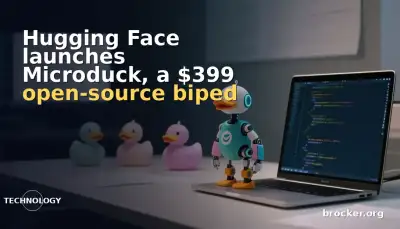
Hugging Face and Pollen Robotics published Microduck's full software stack on GitHub under Apache-2.0 — runtime, SDK, simulation environments, and reinforcement-learning training code — alongside a $399 pre-order for the 25-centimeter biped hardware. The robot walks, roller-skates on optional wheeled feet, picks up small objects with its articulated beak, and recovers from falls; first deliveries are targeted before Christmas 2026 in North America, Europe, and the UK.
Microduck weighs under 800 grams and runs its control loop at 50 Hz on a Rockchip RK3566 processor, driving 15 servos through neural policies trained in simulation and exported to ONNX for deployment. The companion microduck_rl repo documents MuJoCo Warp, PPO, domain randomization, and sim-to-real export. Pollen confirmed it has no plans to open-source the hardware design, so the platform is software-open rather than fully open hardware — but the training pipeline is inspectable and forkable today.
What's new
- Price and availability: $399 introductory pre-order; shipping before Christmas 2026.
- Hardware: Rockchip RK3566, 1 GB RAM, 32 GB storage, front camera, depth sensor, LiDAR, two IMUs, 15 servos at a 50 Hz loop, articulated beak/head/neck/legs.
- Size and weight: 25 cm tall, about 800 g.
- Colors: Cream, Graphite, Lavender, Sky.
- Behaviors: walking, roller-skating with optional wheeled feet, crouching, ground pick-up, ball kicking, sit/stand transitions, autonomous fall recovery.
- Software: Rust service-oriented runtime (robotd, updaterd, configd, btd, padd, mediad, tofd) over Unix-socket JSON-RPC; microduck_rl uses MuJoCo Warp, PPO, domain randomization, and ONNX export with baked-in observation normalization.
- Extras: optional roller-skate feet pack; each unit generates a unique synthetic voice on first boot.
Microduck follows Reachy Mini and Reachy Mini Lite as Pollen's third Hugging Face-era product, but it is mobile and legged rather than a desktop arm. Pollen estimates the beak can lift roughly 100 g, so the duck is a research and education platform rather than a general-purpose manipulator.
Why it matters
Most capable biped platforms still cost far more than $399 and keep their sim-to-real recipes closed. Microduck puts simulation, training, ONNX export, and onboard deployment on a desk-sized budget, which matters for classrooms and small labs running multi-unit reinforcement-learning experiments. The shared 61-dimensional observation contract across policies also enables hot-swapping behaviors at runtime.
The open question is durability and schedule: repeated falls stress hardware quickly, and Pollen's Christmas 2026 ship window still has to hold in production.
Our take
The price point and GitHub-first pipeline are the story — not the duck form factor alone. If the community adopts the ONNX policy format and MuJoCo Warp environments, Microduck could become a low-cost benchmark for sim-to-real transfer. Nvidia's reported interest in acquiring Hugging Face adds strategic context, but the near-term test is whether pre-order units ship on time and whether 1 GB RAM plus a 50 Hz loop stay sufficient beyond locomotion demos.
Sources
- GitHub: pollen-robotics/microduck
- GitHub: pollen-robotics/microduck_rl
- Pollen Robotics: Meet Microduck
- IEEE Spectrum: Adorable Microduck Robot Roller Skates and Plays Soccer
- TechCrunch: Hugging Face is selling a $399 open source duck robot, Microduck
- The Verge: Hugging Face's new robot is an adorable rollerskating duck