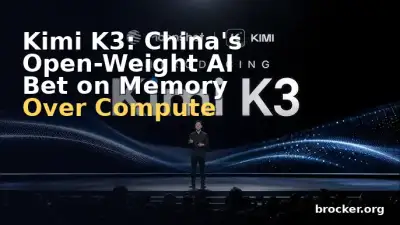
Moonshot AI has released Kimi K3, a 2.8-trillion-parameter open-weight model that Moonshot positions as its largest public release to date. Rather than presenting the model as a simple workaround for US chip export controls, the company’s technical narrative frames K3 as a design that relocates the bottleneck from raw compute toward memory, pooling, and serving efficiency.
Related: Earlier coverage: Kimi K3: World's First Open 3T-Class Model With Native Multimodality.
That distinction matters. Export restrictions have constrained access to top-end accelerators, but K3 still needs serious infrastructure: Moonshot recommends serving it across 64 or more accelerators pooled tightly enough to behave as one system. For most enterprises, that means rented dedicated capacity—not a single on-prem server.
What's New / Specs
According to Moonshot’s launch materials and reporting on the release, K3’s headline specs include:
- 2.8 trillion parameters in a mixture-of-experts design with 896 experts and 16 active per token
- 4-bit quantisation-aware training, applied from fine-tuning onward for broader hardware compatibility
- Kimi Delta Attention for long-context efficiency, with Moonshot citing faster decoding at very long sequence lengths
- Attention Residuals and a 1 million token advertised context window
- Native multimodal positioning, with API access via Kimi services
Independent analysis cited in coverage puts the shipped weight footprint at roughly 1.4TB in Moonshot’s 4-bit format—far below the multi-terabyte footprint full-precision weights would require, but still a datacentre-scale deployment.
Moonshot also states that K3’s overall performance still trails frontier closed models such as Claude Fable 5 and GPT 5.6 Sol, while claiming strong results in some domains such as frontend code.
Why It Matters
The strategic story is not just parameter count. Mixture-of-experts reduces the compute needed per token, but it does not remove the need to keep the full parameter set available in memory. Moonshot’s response is to attack memory cost directly through quantisation, attention caching, and pooled serving.
For regional enterprises, the practical question is deployability. Open weights can help with price, data sovereignty, and language coverage—but only if teams can actually run the model. Moonshot says full weights are scheduled for July 27, 2026, while also warning that standard open-source inference stacks may not yet support K3’s newer architectural pieces on day one.
Pricing has moved upmarket as well. Coverage of Moonshot’s API rates points to roughly $3 per million input tokens on cache miss, $0.30 on cache hit, and $15 per million output tokens—cheaper than some frontier closed models, but no longer in the ultra-budget tier occupied by earlier Chinese open models.
Our Take
K3 is best understood as a memory-and-serving bet, not proof that export controls have been neutralised. The model’s size and architecture are genuinely interesting, but enterprises should treat launch date and usable date as separate milestones until weights, tooling, and independent benchmarks are public.
Until then, the responsible read is cautious optimism: Moonshot is pushing open-weight scale forward, but verification, software maturity, and infrastructure cost will decide whether K3 becomes deployable infrastructure or another impressive benchmark headline.
FAQ
What is Kimi K3?
Kimi K3 is Moonshot AI’s 2.8-trillion-parameter open-weight model, built around mixture-of-experts routing, 4-bit training, and long-context attention optimizations.
Does K3 bypass US export controls?
Note exactly. Reporting on Moonshot’s design suggests K3 shifts pressure from compute toward memory and pooled serving rather than eliminating hardware constraints entirely.
When will the weights be available?
Moonshot has said full weights are planned for release by July 27, 2026, but software support in common inference stacks may lag the launch date.
What hardware is needed to self-host K3?
Moonshot recommends a pooled setup of 64 or more accelerators. Independent analysis puts the weight footprint at roughly 1.4TB in the shipped 4-bit format, before long-context serving overhead.
How does K3 compare with frontier closed models?
Moonshot says K3 still trails models such as Claude Fable 5 and GPT 5.6 Sol overall, while showing competitive or leading results in some targeted evaluations such as frontend code.
Related: For full launch specs, API pricing, and technical details, see Kimi K3: Open 3T-Class Model From Moonshot AI.