On 2 September 2026, Nature published work from MIT CSAIL and Motional on the Concept-Wrapper Network (CW-Net) — a way to ground a machine-learning driving planner in human-interpretable concepts without retraining the whole stack from scratch. MIT News and the paper frame the problem plainly: when a robotaxi phantom-brakes, a safety driver or passenger often cannot tell whether the planner “saw” a real hazard or matched the wrong training pattern.
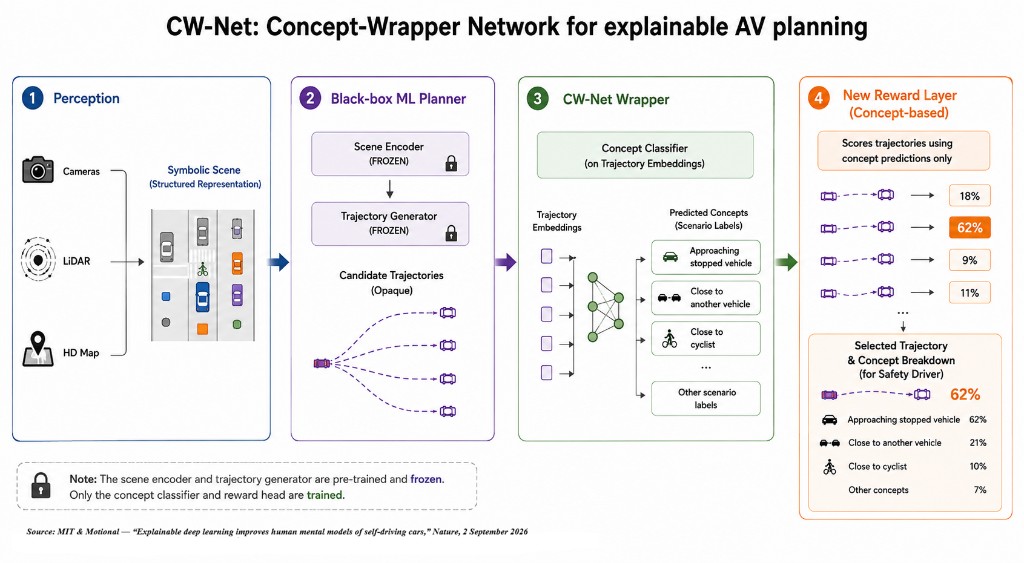
CW-Net is not a chatbot bolted on after the fact. It replaces the planner’s final reward layer with a concept classifier plus a new reward head so the trajectory the car picks is chosen from those concepts — what the authors call a causally faithful explanation.
Confirmed
- Publication: Kenny, Tomov, Shah, Motional CEO Laura Major and colleagues, “Explainable deep learning improves human mental models of self-driving cars,” Nature, 2 September 2026 (open access).
- Method: Applied to an inverse-reinforcement-learning planner that encodes scenes, proposes candidate trajectories, and scores them. CW-Net freezes the pretrained encoder/generator, inserts a concept classifier on trajectory embeddings, and trains a new reward layer so decisions track concept assignments such as “Approaching stopped vehicle,” “Close to another vehicle,” or “Close to cyclist.”
- Driving metrics: On nuPlan closed-loop benchmarks, CW-Net matched the black-box planner within <1% across reported metrics — the paper’s claim that wrapping did not materially degrade simulated driving performance.
- On-vehicle tests: Deployed on a Motional robotaxi with a safety driver on a private track (Lab2Car). Documented cases include: (1) stopping next to parked cars — driver blamed a pickup zone, CW-Net pointed to “Close to another vehicle,” and moving away restored motion; (2) repeated stops near a traffic cone — driver blamed the cone, CW-Net peaked on “Approaching stopped vehicle,” and removing the cone did not stop the phantom brake (planner-side hallucination relative to training labels); (3) stopping for a cyclist while the BIKE concept stayed near zero — follow-up showed the ML planner was not configured to consume cyclist inputs and a separate backup brake stopped the car.
- Broader studies: Online studies (experts and non-experts) and a Las Vegas public-road replay study (n = 100, SAGAT-style situational awareness) reported improved mental models / prediction in surprising situations when CW-Net explanations were shown.
Unknown
- Concept classifier quality: Held-out concept accuracy in the paper is modest (mean accuracy ~54%, F1 ~0.31 with high recall / low precision). Faithful-to-decision ≠ always correct about the world.
- Production status: Track tests used an experimental Motional deep-learning planner with known shortcomings. Las Vegas public-road collection ran CW-Net while the safety driver often stayed in manual for safety — not a claim that Motional ships CW-Net on customer robotaxis today.
- Coverage: Concept vocabulary and planner architecture are specific; the authors argue the wrapper idea could extend to other stacks (including end-to-end or VLA systems) but do not demonstrate those deployments here.
- Regulatory path: Industry commentary that tools like this may become a transparency baseline is aspiration, not a dated mandate in the paper.
Why it matters
Most “explainable AV” demos either stay in simulation or narrate behavior after the fact. CW-Net’s bet is narrower and stricter: if the final action is literally scored from named concepts, a safety driver can run counterfactuals in the loop (“move away from the parked cars”) instead of guessing. That is closer to how Brocker already treats agent opacity in cyber and coding stacks — demand a causal handle, not a plausible paragraph.
Our take
The useful result is not “we solved the black box.” It is that a thin, architecture-aware wrapper can make an experimental planner’s failures testable for the human in the seat — including when the explanation reveals the planner was wrong about the scene. Treat the <1% metric parity as paper-reported, and the ~54% concept accuracy as the reminder that readable labels still need calibration before anyone markets them as passenger trust UI.