Lead
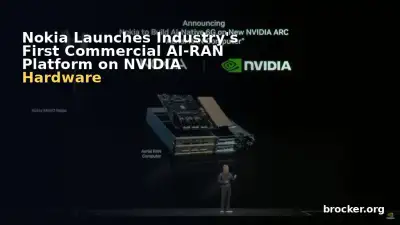
Nokia unveiled the industry's first commercial AI-native radio access network (AI-RAN) platform on July 15, built on its anyRAN software and NVIDIA's Aerial accelerated computing system. The platform claims more than 20% spectral efficiency gains in testing and targets over 100% — effectively doubling existing spectrum capacity — by 2028.
What's New / Specs
The AI-RAN platform runs AI-driven radio algorithms directly on NVIDIA GPU-accelerated baseband hardware rather than traditional fixed-function silicon. Nokia reports it has already demonstrated more than 20% spectral efficiency gains through AI-based radio innovations and is targeting 50% by 2027 and more than 100% by 2028.
The software is delivered through a subscription model, meaning operators gain new features and capacity improvements without hardware swaps. Nokia offers three hardware paths:
- AirScale capacity plug-in card: A GPU-powered expansion card for existing Nokia AirScale base stations, designed as the simplest upgrade for current Nokia customers. Also supported by AI-accelerated merchant silicon from Marvell.
- Standalone AI-RAN node: A dedicated GPU-powered base station supporting 4G, 5G and future 6G workloads, deployable standalone, in clusters, or alongside AirScale as a single logical base station.
- Cloud-native AI-RAN: GPU-powered COTS server solutions delivered through ecosystem partners for operators pursuing cloud-native architectures.
All three options are fully compliant with Open RAN standards and support multi-vendor deployments. Nokia plans pilot deployments by the end of 2026 and commercial availability in 2027.
Why It Matters
Radio access networks account for the largest share of telecom infrastructure spending, and capacity gains have historically required hardware换代 cycles. Nokia's shift to a software-defined, GPU-accelerated architecture lets operators extract more capacity from existing spectrum assets without replacing radio units.
The launch carries particular weight for Nokia itself. The mobile networks business has been CEO Justin Hotard's hardest turnaround problem since he took over in 2025. The partnership with NVIDIA, which included a $1 billion investment for roughly a 3% stake in October 2025, sits at the center of that strategy. By adopting NVIDIA's CUDA ecosystem instead of developing custom silicon, Nokia reduces in-house R&D costs and shifts toward a software-centric model that investors have rewarded through 2026.
Nokia's CTO Pallavi Mahajan has acknowledged that at least some Layer 1 software is tied to NVIDIA's hardware, creating a dependency that competitor Ericsson has deliberately avoided. Ericsson began selling an AI-in-RAN software subscription in June 2026 that runs on operators' existing baseband silicon with no GPU required, reporting up to 20% higher downlink throughput and up to 10% better spectral efficiency across more than 15 live deployments.
Omdia analyst Rémy Pascal, quoted in Nokia's announcement, estimates the cumulative AI-RAN market opportunity above $200 billion by 2030.
Our Take
Nokia's "industry's first" claim holds on a narrow definition: it is the first GPU-accelerated AI-RAN platform sold commercially. Ericsson reached the market first with AI features layered onto existing silicon, but Nokia has chosen a fundamentally different architecture that ties its radio roadmap directly to NVIDIA's compute stack.
That dependency carries both upside and risk. Outsourcing the silicon race to the dominant AI-chip supplier is a rational response to a business Nokia could not fix on its own, and the subscription model gives radio the recurring revenue its hardware cycles never did. But the headline efficiency numbers are targets for 2027–2028, not current results, and the platform is not yet commercial. Nokia's comeback is in motion, not complete, and its trajectory now runs through NVIDIA.
FAQ
When will Nokia's AI-RAN platform be available?
Pilot deployments are scheduled for the end of 2026, with commercial availability expected in 2027.
Does the AI-RAN platform work with existing Nokia equipment?
Yes. The AirScale capacity plug-in card is designed for Nokia's installed AirScale base. The platform also supports standalone nodes and cloud-native deployments, and is fully Open RAN compliant for multi-vendor environments.
How does this compare to Ericsson's AI-RAN offering?
Ericsson began selling an AI-in-RAN software subscription in June 2026 that runs on existing baseband silicon with no GPU required, reporting up to 20% higher downlink throughput. Nokia's platform requires NVIDIA GPU acceleration but targets higher spectral efficiency gains (100%+ by 2028 vs Ericsson's ~10% reported improvement) through a more aggressive AI-native architecture.
What role does NVIDIA play in this platform?
NVIDIA supplies the Aerial AI-RAN platform and GPU acceleration hardware. The company also holds roughly a 3% stake in Nokia following a $1 billion investment in October 2025. Nokia's anyRAN software runs on NVIDIA's CUDA ecosystem.
Will operators need to replace their existing radios?
No. The AI-RAN platform works with existing Nokia or ORAN-compliant radio units. The upgrade is in the baseband processing layer, not the radio hardware itself.