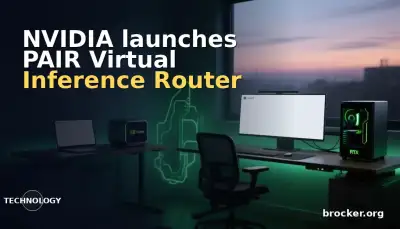
On September 3, 2026, NVIDIA released the beta of its Personal AI Router (PAIR), a virtual inference router that distributes independent inference requests across compatible systems on a local network. The software works with existing Ollama and LM Studio interfaces without requiring changes to agent harnesses, letting a lead agent hand off subagent tasks to spare GPUs on other machines.
PAIR discovers participating systems using mDNS, secures connections with mTLS, and schedules each request to one eligible node based on real-time readiness, engine state, model presence, and GPU utilization. Supported hardware includes NVIDIA GeForce RTX 20 Series and newer, RTX PRO workstation GPUs (Turing architecture and newer), DGX Spark, and Apple M4+ silicon across Windows, macOS, and Linux.
What's new
- No new API: PAIR proxies the standard Ollama and LM Studio endpoints, so agents keep using the interface they already expect.
- Elastic nodes: Systems can join or leave the pool dynamically — a gaming PC can reclaim its GPU, a laptop can sleep, and PAIR adjusts scheduling accordingly.
- Local-only traffic: Prompts, data, and inference stay on the user's private network.
- Model-aware routing: The scheduler only assigns a request to a node that has the exact requested model loaded; different nodes can host different models.
How it works
After installation on each supported machine, PAIR uses mDNS to discover nearby systems. The user approves a secure pairing request, establishing a trusted set of nodes. All inter-node communication is blocked until pairing completes, then secured with mTLS and generated certificates.
Each node runs Ollama or LM Studio. PAIR can help install an engine and initiate model downloads on paired systems. When a compatible application sends an inference request through the local endpoint proxied by PAIR, the router inspects the engine and model requirements, filters the paired systems for eligibility, selects one node, and streams the response back through the same local interface. The Jobs and metrics views show which node handled each request.
Demo results
In a five-subagent demonstration using Hermes Desktop and Ollama with Qwen 3.6 35B A3B, a single RTX Spark laptop completed the workload in 18 minutes on average. A three-device PAIR cluster — RTX Spark laptop, DGX Spark, and RTX 5090 — finished in 8 minutes 48 seconds. NVIDIA emphasizes this is an unofficial, configuration-specific demo, not a general benchmark or a promise of linear scaling. Results depend on workload parallelism, model, engine settings, hardware, network, and node availability.
Why it matters
Multi-agent workflows are becoming common for coding, research, and automation, but they bottleneck on a single GPU when dozens of independent model calls compete for the same execution slots. PAIR lets the inference layer widen with the agent, keeping the primary workstation free for graphics-intensive tasks while distributing inference to other local hardware. For small studios and prosumers, this reduces the pressure to move immediately to cloud inference when local capacity runs thin.
Confirmed
- Release: NVIDIA shipped the PAIR beta on September 3, 2026, per the company's technical blog.
- Drop-in compatibility: PAIR proxies the standard Ollama and LM Studio endpoints, so existing agent harnesses work without changes.
- Security model: Discovery uses mDNS; inter-node traffic stays blocked until pairing is approved, then is secured with mTLS and generated certificates.
- Hardware support: GeForce RTX 20 Series and newer, RTX PRO workstation GPUs (Turing and newer), DGX Spark, and Apple M4+ silicon on Windows, macOS, and Linux.
- Model-aware routing: A node is only eligible for a request if it has the exact requested model loaded.
Unknown
- The demo speedup (18 minutes on a single device vs. 8 minutes 48 seconds on three devices) is NVIDIA-reported from one configuration and has not been independently benchmarked.
- Real-world gains on less parallel workloads, slower home networks, or fluctuating node availability are unmeasured outside NVIDIA's demo.
- Beta limitations, support cadence, and any licensing or pricing terms beyond the beta are not stated in the announcement.
Our take
PAIR solves a real coordination problem for local multi-agent workloads without demanding a cluster rewrite, but the gains hinge on workload parallelism and network latency. The demo shows a 2.1× speedup on a highly parallel task; less parallel workloads will see less benefit. The requirement that each node already have the exact model loaded also means storage and VRAM must be provisioned per machine — PAIR does not shard a single model across GPUs.