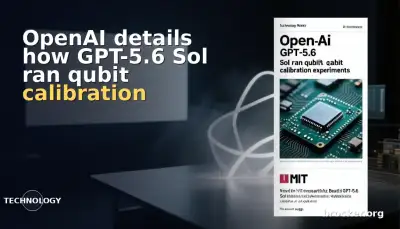
On 8 September 2026, OpenAI published an account of how a graduate researcher used GPT‑5.6 Sol, connected to Codex, to run superconducting-qubit experiments at MIT. Beatriz Yankelevich, a graduate student in MIT's Engineering Quantum Systems Group (EQuS), integrated the agent into the lab software that coordinates experiments, letting it run measurements, analyze results, and decide what to try next.
The setup is unusual for a frontier-model story because the model is not writing code for a benchmark. It is driving hardware. Once a superconducting qubit chip has been fabricated, packaged, and cooled, researchers interact with it entirely through software — which is what made the experiment a natural testbed for an agent.
Agent calibration loop — workflow OpenAI describes for the MIT EQuS test
- Chip ready: fabricated, packaged, and cooled; researchers then interact with it only through software.
- Choose and run: the agent selects measurement parameters and operates the hardware.
- Analyze: it reads the data and either refines the measurement or saves the result.
- Write back: the saved result shapes the next measurement — a closed loop on physical hardware.
Confirmed
EQuS studies superconducting qubits, cooled to near absolute zero inside dilution refrigerators. The qubits perform operations quickly, are controlled with microwave signals, and can be arranged on a chip using familiar manufacturing techniques. OpenAI says the group now regularly uses agents to handle routine measurements.
Yankelevich tested GPT‑5.6 Sol on an uncalibrated six-qubit chip, one of a standard type EQuS uses to benchmark its fabrication process. She gave Codex measurement-specific skills explaining how to run and evaluate each experiment. Using those skills and the chip's design targets, the model chose measurement parameters, operated the hardware, analyzed the data, and then either refined the measurement or saved the result for the next step.
When signals were clear, Codex completed a standard measurement sequence with little researcher intervention. According to OpenAI, it identified the qubit's transition frequencies, calibrated the pulses used to control and read it, and determined how long the qubit retained quantum information.
Calibration is a chain of interdependent measurements, each result shaping the next. Qubit properties can drift, and unexpected physical behavior can produce inconsistent results. Experienced researchers recognize those changes and adapt; the question was whether an agent could.
EQuS fabricates many of these standard chips, and each can take a researcher several days to characterize. Yankelevich said she can now have agents running measurements for many hours overnight or while she works in the cleanroom, checking in from her phone and steering them when something needs fixing.
Unknown
The account is a single-lab case study published by the model vendor, not an independent evaluation. There is no published error rate, no comparison against an experienced researcher's calibration time, and no detail on how often the agent's saved results had to be discarded.
OpenAI is explicit about the limits. GPT‑5.6 Sol had more difficulty when experimental signals were weak or noisy. In those cases it took longer to find suitable measurement parameters and sometimes needed guidance from an experienced researcher. The company's own conclusion is that current agents can handle clearly defined experimental workflows, but interpreting ambiguous physical results remains a challenge.
OpenAI also notes that experienced researchers may still identify the best calibration settings faster than current AI models. For novel experiments, Yankelevich assigns the agents narrower goals and leans more on their ability to write, modify, and test new code for control, analysis, and simulation.
Nothing here establishes that agent-driven calibration generalizes beyond EQuS's standard six-qubit chips, or that it holds up on other qubit modalities. The lab's own workflow is described as relatively well-defined, which is precisely the condition under which agents tend to look strongest.
Our take
The notable part is not that an agent can run a measurement sequence — it is that the lab let it write results back into the next measurement. That is a closed loop with physical hardware attached, and the failure mode is a quietly wrong calibration rather than a wrong sentence. With no discard rate or audit trail published, the practical question for other labs is verification: who checks the saved result before the next experiment depends on it.