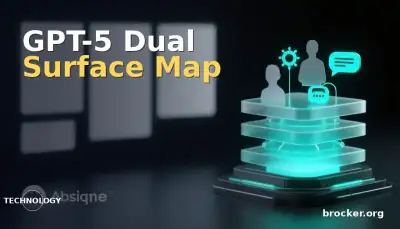
This piece maps GPT-5’s dual surface (ChatGPT system vs API family) — sibling stack pieces are in navigation below.
On August 7, 2025, OpenAI introduced GPT-5 as more than a single model name. In ChatGPT it is a unified system — reasoning, non-reasoning, and a router that decides when to think longer. In the API it is a developer family: gpt-5, gpt-5-mini, gpt-5-nano, plus gpt-5-chat-latest for the non-reasoning ChatGPT path. That dual surface — consumer system versus explicit developer SKUs — still shapes how GPT-5-class models ship.
Summer 2026 did not erase the map; it layered it. OpenAI took GPT-5.6 to general availability on July 9, 2026 with Sol, Terra, and Luna tiers across ChatGPT, Codex, and the API — then kept splitting which surface gets which tier.
That layering kept the dual-surface map relevant into the GPT-5.6 season.
What OpenAI confirmed at GPT-5 launch
- ChatGPT: GPT-5 became the default for signed-in users, replacing GPT-4o, o3, o4-mini, GPT-4.1, and GPT-4.5. The system applies reasoning automatically when useful; paid users can force “GPT-5 Thinking.”
- GPT-5 Pro: Extended-reasoning variant for the hardest tasks (Pro plan), replacing o3-pro in that seat.
- Access by plan: Free vs paid differs mainly by usage volume; free users who hit GPT-5 limits fall back to GPT-5 mini. Enterprise/Edu followed the consumer/Team rollouts.
- API (same day): Reasoning-focused gpt-5 / gpt-5-mini / gpt-5-nano on Responses and Chat Completions; launch pricing $1.25/$10, $0.25/$2, and $0.05/$0.40 per million input/output tokens respectively. gpt-5-chat-latest exposes ChatGPT’s non-reasoning path at the standard GPT-5 token rates.
- Developer controls: reasoning_effort (including minimal), verbosity, custom tools with optional context-free grammars, and Codex CLI defaulting to GPT-5.
How GPT-5.6 extends the same architecture
OpenAI’s GPT-5.6 materials position a three-tier family — Sol (flagship for complex work), Terra (balanced), Luna (fast/low-cost) — available across ChatGPT Work, Codex, and the API. In standard ChatGPT conversations, Sol is the paid chat face; Terra and Luna are not manually selectable there the same way they are in Work/Codex/API. August 2026 product updates further split ChatGPT chat optimizations from Work/Codex (for example, Sol chat updates that OpenAI said do not change the Work/Codex Sol path) and expanded Free/Go default toward Luna with unlimited everyday text chats under abuse guardrails.
Read that carefully: OpenAI is not shipping “one model everywhere.” It is shipping named capability tiers across product surfaces — chat product, work product, coding product, API — with different pickers and limits.
Why this map matters
Anthropic’s 2026 season split access (Fable vs Mythos). OpenAI’s durable design choice is different: surface + tier. The same brand (“GPT-5” / “GPT-5.6”) means a router system in the consumer app and explicit SKUs in the developer platform — a map buyers still need before Responses API, Agents SDK, or computer-use tooling make sense.
Our take
In our view, GPT-5’s dual surface is the real product announcement — benchmarks ride on top of it. Once ChatGPT is a system and the API is a family, every later release (including GPT-5.6 Sol/Terra/Luna) becomes a remapping of tiers onto surfaces, not a single scoreboard win.
Series: OpenAI Product Stack · next: Responses API & Assistants sunset.