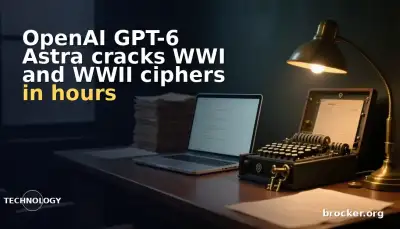
Developer Carter Leffen used OpenAI's GPT-6 Astra to break two historical ciphers this week — a German Army Enigma message from July 1941 and a World War I ADFGVX radio cipher from November 1918. The Enigma break recovered the full machine setup in roughly 10 hours of model time after Leffen supplied a crib from a related solved message; the WWI cipher yielded a plaintext describing an English cruiser arriving at Sevastopol, with the model independently identifying the encryption key "TRUPPENVERSCHIEBUNG" and cross-checking the result against historical naval logs.
Frode Weierud's CryptoCellar archive has logged the Enigma solution and credited Leffen by name. The WWI message, previously listed among unsolved ciphers, was decoded after GPT-6 Astra searched archives, built a simulator, wrote cryptanalysis code, and tested keys in parallel. Leffen noted that the website documenting the Enigma solution took 99 times more work than the codebreaking itself.
Confirmed
- Enigma intercept: indicator MVUEH, dated July 10, 1941, German Army traffic during the invasion of the Soviet Union.
- Recovered setup: rotor order II-V-III with 10 plugboard pairs.
- Crib: repeated place name "Rosenow" from a related solved message narrowed the search to 14.8 million key checks.
- Plaintext recovered: "Please specify the route of march. I am in Rosenow, Rosenow. Immediate reply by radio."
- Two independent implementations reproduced the Enigma plaintext.
- WWI ADFGVX message: transmitted November 27, 1918, 170 characters, previously unsolved.
- Decoded plaintext (German): "EIN ENGLISCHER KREUZER EINLIEG X SEWASTOPOL X S4STEN X EIN GESCHWADER DER X ALLIIERTEN FOLGT 26STEN X" — an English cruiser arrived at Sevastopol on the 24th, an allied squadron follows on the 26th.
- Encryption key identified: "TRUPPENVERSCHIEBUNG" (described in J. Rives Childs, "The History and Principles of German Military Ciphers, 1914–1918", pp. 214–215).
- Historical cross-check: HMS Canterbury logs confirm arrival at Sevastopol on November 24, 1918; allied squadron arrived November 26.
- CryptoCellar archive logged the Enigma break and credited Leffen; the WWI decode was published on prinzai.com on September 17, 2026.
Unknown
- Whether GPT-6 Astra is generally available or remains a restricted-access research model.
- Exact compute cost and token usage for the 10-hour Enigma run and the WWI decode.
- Whether the ADFGVX key discrepancy (key documented from December 9, 1918, used on a November 27 message) reflects a historical anomaly or a model hallucination.
- No independent replication of the WWI ADFGVX decode has been reported yet.
- OpenAI has not publicly commented on either result.
Our take
The breaks demonstrate that a large language model with tool use can automate the grunt work of historical cryptanalysis—archive search, simulator construction, parallel key testing—once a human supplies critical judgment. Neither result threatens modern cryptography; Enigma and ADFGVX are 1930s-era systems with tiny key spaces compared to AES or elliptic-curve schemes. The signal: division of labor between execution and direction will matter more when the target is legacy code or logic.