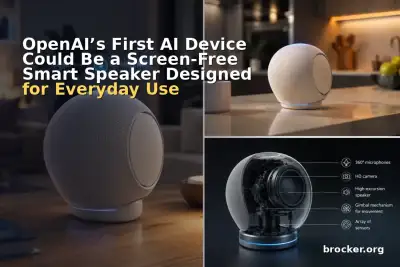
OpenAI's first major consumer device may not be a phone, a pair of glasses, or a wearable. According to recent reports, the company is working on something much simpler on the surface: a portable smart speaker without a screen.
If the details are accurate, the device would be built around ChatGPT and designed for voice-first use inside the home. That makes the product sound familiar at first, but OpenAI is likely aiming for something more conversational than today's smart speakers.
A quieter entry into AI hardware
Ever since OpenAI began working with former Apple design chief Jony Ive, expectations around its hardware plans have been high. Many people assumed the first product would try to reinvent the smartphone or introduce a new wearable category.
A screen-free speaker would be a more modest starting point, but it may also be the more practical one. Voice remains one of the most natural ways to interact with an assistant at home, especially when people are cooking, working, reading, or moving between rooms.
The key question is whether OpenAI can make the experience feel meaningfully better than products like Amazon Echo or Google Nest.
Built around ChatGPT conversations
The reported device would put ChatGPT at the center of the experience. Users could ask questions, get help with planning, manage simple tasks, control connected home devices, or use the speaker as a hands-free assistant throughout the day.
What could make it different is the quality of conversation. Traditional voice assistants often work well for short commands but struggle with follow-up questions, context, and more complex requests. ChatGPT gives OpenAI a stronger base for multi-step conversations.
That advantage will matter only if the device feels fast, reliable, and useful in ordinary situations. Hardware succeeds when people reach for it without thinking.
Why cameras and sensors matter
Reports also suggest that the device could include cameras and environmental sensors. If true, those features may help the assistant understand what is happening around it and respond with more context.
For example, a home assistant that can understand a room, recognize objects, or react to activity could feel more capable than a speaker that only hears voice commands.
Privacy will be the difficult part. A screen-free AI device with cameras inside the home will need very clear controls, visible indicators, and strong data protections. OpenAI cannot rely on novelty alone; people will want to know when the device is listening, seeing, storing, or sending information.
Jony Ive's role
Jony Ive's involvement is one reason the project is attracting attention. His team helped define the look and feel of several major Apple products, and OpenAI will want a device that feels less like a gadget and more like a natural part of daily life.
That design challenge is not only about appearance. It is about behavior: how the device wakes, speaks, moves, responds, and fades into the background when it is not needed.
Why this matters for OpenAI
OpenAI has built one of the most recognizable AI software brands in the world. Hardware would give the company a more direct relationship with consumers and a stronger presence outside the browser or mobile app.
It would also place OpenAI in competition with companies that already own the living room, including Amazon, Google, and Apple. Those companies have distribution, hardware experience, and smart-home ecosystems. OpenAI has the AI brand and conversational model.
Our take
A screen-free smart speaker is not the flashiest possible first device, but it may be a smart test of OpenAI's consumer hardware ambitions.
If the product only answers questions, it will feel redundant. If it can hold useful conversations, understand context, respect privacy, and complete everyday tasks with less friction than existing assistants, it could mark the beginning of a new category of AI companion devices.
Frequently asked questions
What is OpenAI reportedly building?
Reports say OpenAI is developing a portable, screen-free smart speaker powered by ChatGPT for voice-based use in the home.
Has OpenAI officially announced the device?
No. The product has not been formally announced, and details about price, release date, and final design remain unconfirmed.
Why would OpenAI make hardware?
Hardware would let OpenAI bring ChatGPT into daily life more directly instead of relying only on apps, browsers, and third-party platforms.
Sources
- TechCrunch
- Reuters
- Bloomberg reporting referenced by Reuters