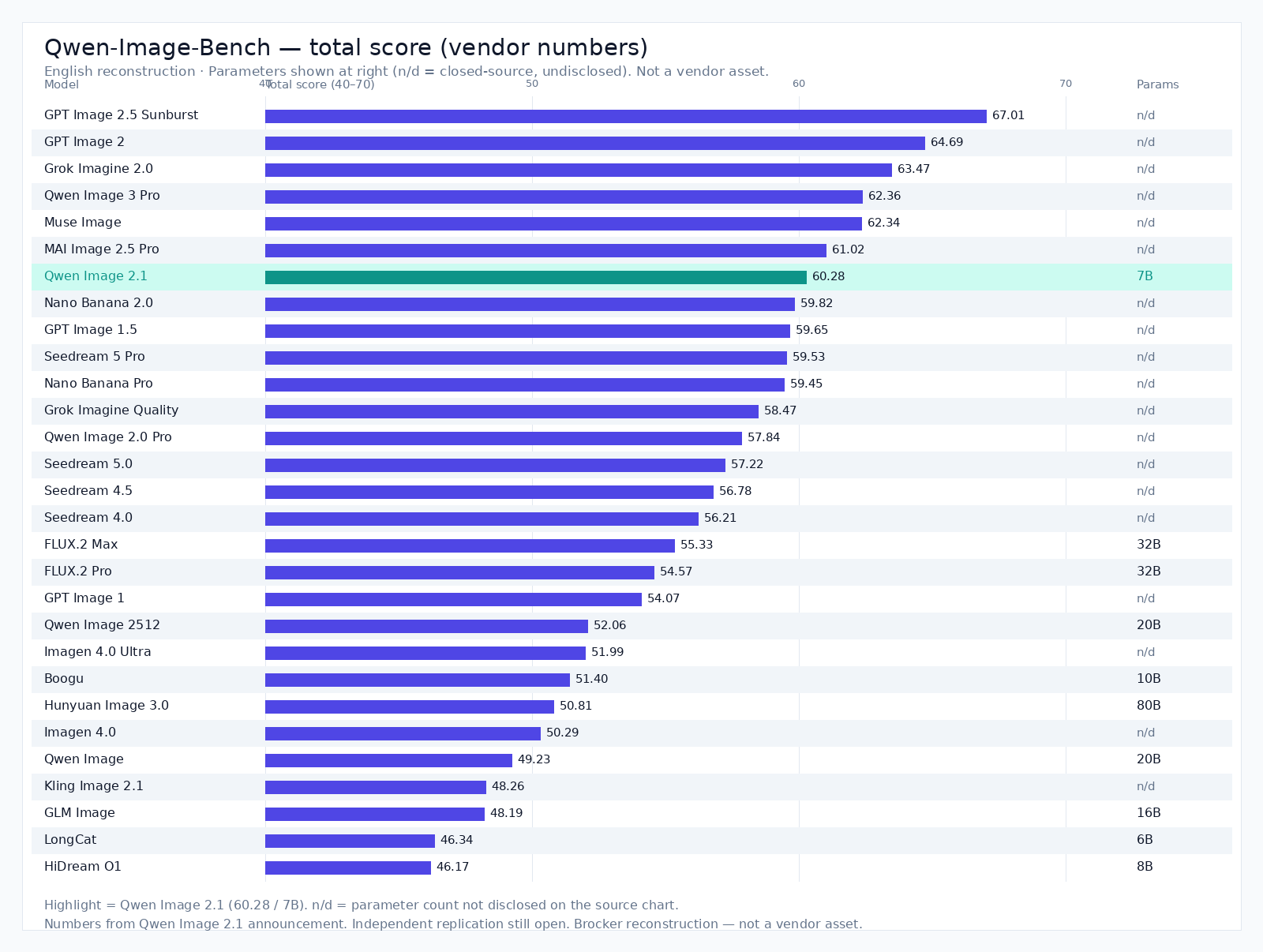
Alibaba's Qwen team has open-sourced Qwen-Image-2.1, a unified text-to-image generation and image editing model. Its visual generation component packs into 7 billion parameters across 32 single-stream DiT layers.
Announced on September 20, 2026, the release merges capabilities that previously required separate models: standard image generation, transparent RGBA output, subject extraction from photographs, and multi-reference editing with up to ten input images.
The model uses a mixed-granularity attention architecture: text tokens receive a token-level causal mask, while image generation uses a chunk-level mask. Prefix KV cache reuse lets input images and editing instructions serve as static context, computed once and cached to cut memory usage during multi-image editing workflows.
Confirmed
- Visual generation component: 7B parameters, 32 single-stream DiT layers
- Unified model handles text-to-image, image editing, transparent RGBA generation, and subject extraction
- Native transparency support with prompt-controlled RGBA output
- Up to 10 reference images for multi-subject composition
- Local editing via circles, painted annotations, or separate mask inputs
- Portrait identity and product consistency fidelity improvements
- Native 2K resolution support across seven aspect ratios (1:1, 4:3, 3:4, 3:2, 2:3, 16:9, 9:16)
- Default inference: 40 denoising steps at bfloat16 precision
- Day-0 framework support: Diffusers (QwenImage21Pipeline), ComfyUI (Comfy-Org repackaged weights), vLLM-Omni, SGLang, LightX2V
- Prompt rewriting models available: Qwen/Qwen-Image-2.1-PE-T2I (text-to-image) and Qwen/Qwen-Image-2.1-PE-I2I (editing)
- License: qwen-research (per Hugging Face model card)
- Weights hosted on Hugging Face (Qwen/Qwen-Image-2.1), ModelScope, and Comfy-Org/Qwen-Image-2.1 for ComfyUI
Unknown
- Independent benchmark replication of Qwen-Image-Bench scores shown in the announcement
- VRAM requirements for 2K generation at bfloat16 and int8 quantized variants
- Quantitative fidelity metrics for portrait identity and product consistency preservation
- Commercial licensing terms beyond the qwen-research designation
- Training data composition and any copyright-filtering methodology
Our take
Qwen-Image-2.1's consolidation of transparency, extraction, and multi-reference editing into a single 7B model cuts the model-zoo sprawl developers juggle. Prefix KV caching attacks the memory bottleneck that keeps multi-image editing off consumer GPUs, and day-0 support across Diffusers and ComfyUI means the integration work is largely done. The open question is whether the qwen-research license permits the commercial fine-tuning and deployment that drove adoption of earlier Qwen releases.