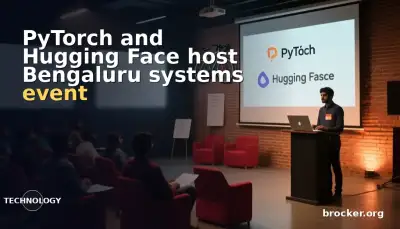
More than 170 students, engineers, researchers, and open-source contributors gathered in Bengaluru for a technical evening hosted by Red Hat and Hugging Face, focused on PyTorch and the systems layers underneath modern ML: profiling, large-scale inference, reinforcement-learning environments, distributed training, and GPU communication primitives. Three speakers came from Hugging Face; two from Red Hat’s PyTorch engineering team.
Sudhir Dharanendraiah framed the night around a concrete shift: India should not stay only a large consumer of AI and ML tools. The opportunity is more builders and maintainers of the stack itself — profilers, runtimes, training abstractions, RL tooling, kernels, and distributed communication layers.
Confirmed
- Hosts & scale: PyTorch’s official blog posts the Bengaluru evening as a Red Hat + Hugging Face event with more than 170 attendees and a systems-first agenda rather than a general AI meetup.
- Profiling workflow (Hugging Face — Aritra Roy Gosthipaty): Demonstrated a repeatable PyTorch profiler path with torch.profiler.record_function, torch.profiler.profile, and wait/warmup/active schedules — including the “overhead bound” case where CPU launch costs dominate small GPU workloads.
- Inference stack (Hugging Face — Adarsh): Framed serving thousands of concurrent requests as the real systems problem. Covered SGLang, RadixAttention (radix-tree KV prefix cache with LRU behavior), and a split where Transformers stays the model-definition/tokenizer/weight source of truth while SGLang owns scheduling, continuous batching, and attention backends.
- Kernels direction (Hugging Face): Presented an effort toward more reproducible builds, cleaner packaging, better PyTorch compatibility, and easier community distribution of custom/accelerator kernels — stated as goals for the kernels work, not as shipped performance numbers.
- RL environments (Hugging Face — Adithya S Kolavi): Positioned programmatically verifiable rewards and OpenEnv-style Gym-like APIs (tools via MCP, embedded rubrics, TRL-style training hooks) as a post-training substrate. Repo2RLEnv was introduced as turning public repositories into verifiable RL environments.
- Distributed training (Red Hat — Mansi Agarwal): Walked DeviceMesh, DTensor, and FSDP2 as a composability path for multi-dimensional parallelism, and named live constraints: DTensor eager-mode overhead, incomplete operator coverage, and limits of greedy sharding propagation.
- Communication substrate (Red Hat — Arkadip Maitra): Closed on zero-copy GPU-to-GPU paths beyond classic c10d assumptions, citing GPUDirect RDMA, stronger NVLink paths, and topology-aware fabrics as the changing backdrop.
Unknown
- Conversion to maintainers: The blog argues for a deeper contributor pipeline. It does not report how many attendees already contribute upstream, or any follow-up program metrics after this single evening.
- Kernels / zero-copy outcomes: Packaging goals and communication speedups were discussed in the talks; the post does not publish independent benchmarks or a release schedule Brocker can treat as shipping facts.
- OpenEnv / Repo2RLEnv maturity: Presented as directions and APIs for the post-training era — not as a claim that standardized LLM RL environments are universally adopted.
Our take
This is a useful signal if you care who writes the stack under the models: Red Hat’s PyTorch internals talks plus Hugging Face’s inference/RL tooling is the right pairing for “builders, not only consumers.” One well-attended evening does not prove a maintainer pipeline — the test is whether profilers, kernels, and distributed runtimes gain sustained Indian contributors after the slides are posted.