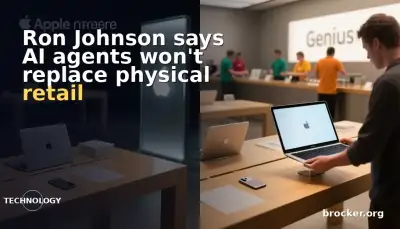
Ron Johnson, the former Apple retail chief who built the company's store network from the ground up, is pushing back against Silicon Valley's enthusiasm for AI agents that shop on consumers' behalf. In an interview, Johnson argued that physical stores will keep thriving because certain purchases — high-consideration items like laptops — require hands-on experience no AI can replicate.
"AI is a new technology that will improve the online shopping experience," Johnson said. "But I don't know that it's going to change which way we shop." His skepticism lands as Google rolls out its Universal Commerce to help AI agents handle product discovery through checkout, and OpenAI turns ChatGPT into a shopping destination where users can research, compare, and buy without leaving the chat.
What Johnson said
Asked whether consumers would let an AI agent choose and buy a $1,000 to $2,000 laptop without ever visiting a store or website, Johnson was direct: "Honestly, nobody's going to do that." Buying a laptop is too personal a purchase to delegate entirely, he said. Buyers want to feel the weight, see the display, and judge which size works for them. AI may narrow the choices, he acknowledged, but many consumers will still want to experience the product themselves before spending that kind of money.
"AI will never be able to have you physically experience a product," Johnson said. Instead, he expects agents to better inform consumers before they walk into a store: "They'll just become more informed shoppers when they come to the store."
Apple's retail philosophy
Johnson's conviction stems from the retail model he built at Apple starting in 2000, when online shopping was just taking off. Apple's stores were designed not only as places to buy products, but as spaces where people could try devices, learn how to use them, and return for help when something went wrong. Competitors copied Apple's glass-heavy design, open layouts, and versions of the Genius Bar, Johnson said, but often missed the core differentiator: the people.
"The secret sauce for Apple has always been its people, the people in the store, and how they treat the customer," Johnson said. Apple Store employees are not paid on commission, unlike the sales culture common across much of retail. The idea was to remove the pressure to sell and instead have employees figure out what a customer actually needed.
Lessons from J.C. Penney and Enjoy
After leaving Apple, Johnson took over J.C. Penney in 2011 with an ambitious plan to reinvent the struggling department-store chain. He was ousted less than two years later after sales plunged. Johnson now says he tried to change too much, too quickly, without bringing employees and customers along. Apple's stores had effectively been a startup that evolved alongside the company's products; J.C. Penney was a turnaround requiring a different approach. "I applied a startup mentality to what needed to be a turnaround transformation," he recalled.
He later founded Enjoy Technology, an e-commerce company that brought technology products and setup services directly to customers' homes. The startup filed for bankruptcy in 2022 and sold substantially all of its assets to Asurion.
AI optimism with human guardrails
For all his skepticism about AI reshaping shopping behavior, Johnson remains bullish on the technology itself. "I'm a real believer in AI. I'm an AI optimist," he said. He believes Steve Jobs would have embraced AI, too — but not as a substitute for human judgment. "There's no substitute for human intuition," Johnson said, recalling Jobs' belief in bringing smart people together to debate problems and find new ways of looking at them.
Our take
Johnson's track record gives his skepticism weight, but Google and OpenAI are spending heavily to make agents work. The real test isn't whether an AI replaces a store visit for a laptop — it's whether agents capture the low-consideration, repeat-purchase volume that fuels e-commerce margins. If they do, stores shift further toward experience and service, which fits Johnson's own vision. Watch whether his "informed shoppers" actually convert at higher rates.