SenseTime has released the preview version of SenseNova U1.5-Lite-Preview, a lightweight unified multimodal model that packs 8 billion mixture-of-transformers (MoT) parameters into a single architecture capable of native 4K image generation, high-precision editing, and complex prompt following. Announced on August 4, the model builds on the company's proprietary NEO-Unify architecture, which eliminates separate vision encoders and variational auto-encoders in favor of a unified representation space where pixels and language tokens are processed jointly from the ground up. The preview is immediately available worldwide via Hugging Face, GitHub, and ModelScope, with an official release expected in the near future.
The release marks a systematic iteration over SenseNova U1, which debuted in April 2026 as the industry's first model to achieve continuous image-text creative generation within a unified framework. Where U1 validated the feasibility of end-to-end native multimodal modeling, U1.5-Lite-Preview pushes the architecture further: it redesigns the generation head to suppress grid artifacts at high resolution, extends training to 4K, and reorganizes editing data to strengthen preservation of original image content, subject identity, and spatial structure during targeted modifications. SenseTime positions the model as a step toward lowering the barrier for multimodal application development across e-commerce design, advertising, and content creation.
What's New / Specs
- Model scale: 8B MoT (Mixture of Transformers) parameters
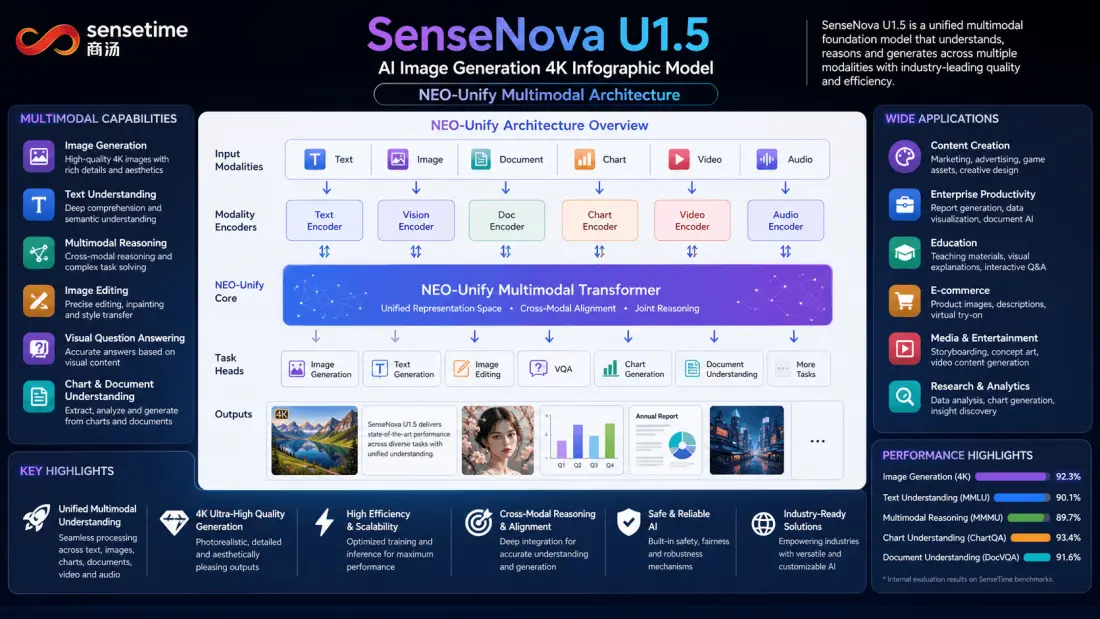
- Architecture: NEO-Unify native unified multimodal framework — no separate vision encoder (CLIP-style) or VAE in the inference pipeline
- Core capabilities: Visual understanding, native 4K image generation, high-precision region-based editing, complex prompt following, reference-image style transfer, Chinese and English text rendering
- Benchmark improvements over SenseNova U1: Qwen-Image-Bench (with Prompt Enhance) 47.14 → 55.20; ImgEdit-Bench 3.90 → 4.37; GEdit-Bench-en 7.47 → 8.17; GEdit-Bench-zh 7.42 → 8.05
- Editing claims: Surpasses several larger-parameter open-source and closed-source models on GEdit-Bench (both English and Chinese subsets)
- Availability: Open-source preview on Hugging Face, GitHub (OpenSenseNova organization), and ModelScope; official version forthcoming
- Supplementary tooling: Prompt Enhance Skill for expanding brief ideas into structured creative proposals; SenseNova-Skills repository with generation examples and prompt-engineering guides
The NEO-Unify architecture underpinning both U1 and U1.5 represents a departure from the conventional multimodal stack that stitches a vision encoder, projector, language model, and separate diffusion or VAE decoder. By operating directly on pixel-space inputs and text tokens within a single transformer backbone, the design aims to reduce information loss across modality boundaries and maintain semantic-pixel alignment throughout generation and editing. SenseTime's April 2026 technical disclosure noted that SenseNova U1 Lite came in two configurations — an 8B-MoT dense backbone variant and an A3B-MoT mixture-of-experts variant — both delivering commercial-grade infographic generation and continuous image-text interleaved reasoning at compact scale.
U1.5-Lite-Preview focuses its upgrades on four dimensions: native 4K resolution support with enhanced detail and realism; more accurate bilingual text rendering for complex layouts; stable editing that precisely distinguishes regions to modify from regions to preserve; and improved visual instruction following for multi-step creative workflows. The generation head redesign specifically targets grid artifacts that typically plague high-resolution synthesis, while the reorganized editing training tasks emphasize content preservation — ensuring that when a user replaces a date or swaps an object, the surrounding composition, lighting, and texture remain intact. The model also demonstrates reference-image creation capabilities, extracting color palettes, compositions, and design language from one or more input images and applying them to new themes.
Why It Matters
The release arrives at an inflection point where the multimodal model competition is shifting from raw parameter scale toward efficiency, controllability, and practical deployment experience. At 8B MoT, SenseNova U1.5-Lite-Preview is small enough to run on consumer-grade GPUs with quantization, yet SenseTime's benchmark data suggests it matches or exceeds larger commercial closed-source models on specific editing and infographic tasks. This efficiency profile could accelerate adoption among developers and small-to-medium enterprises that lack access to large-scale compute clusters but need production-quality visual generation and editing.
For the Chinese open-source AI ecosystem, the model represents a notable milestone: a domestically developed unified architecture that delivers competitive performance on both Chinese and English benchmarks without relying on external foundation models. The bilingual text rendering improvements address a persistent pain point in multilingual generative workflows, where layout-aware typography in Chinese characters has historically lagged behind Latin-script performance. Meanwhile, the open-source distribution across three major platforms (Hugging Face, GitHub, ModelScope) ensures broad accessibility for global researchers and commercial integrators alike.
From an application perspective, the precision editing capabilities — region-level modifications, simultaneous multi-target edits with texture and lighting consistency, and reference-driven style transfer — move the model closer to professional creative pipelines where iterative refinement is the norm rather than one-shot generation. The Prompt Enhance Skill tool further lowers the expertise barrier by automating the expansion of vague prompts into structured creative briefs. SenseTime also indicated that a delivery-grade SenseNova U1 Pro variant for professional creators and enterprise users is in invitation-only testing, suggesting a tiered product strategy that could monetize the open-source foundation through supported, optimized deployments.
Our Take
SenseTime's decision to open-source a preview model at 8B MoT with native 4K generation and benchmark-beating editing scores is a credible technical achievement, particularly given the architectural discipline of NEO-Unify — eliminating the vision encoder and VAE entirely is a bold design choice that few teams have executed at this capability level. The benchmark gains over U1 are measurable and specific, and the claim of surpassing larger models on GEdit-Bench warrants attention, though independent replication on diverse real-world editing tasks will be the true test.
We should temper expectations around "commercial-grade" claims until the official release arrives with further refinements in generation quality and editing stability, as SenseTime itself acknowledges. The preview label exists for a reason: grid artifact suppression at 4K, long-context prompt adherence, and consistent identity preservation across multi-turn edits are hard problems that often reveal edge cases only under broad community stress-testing. Additionally, the model's reliance on MoT rather than dense attention may introduce deployment complexity for teams accustomed to standard transformer runtimes, though the open-source codebase and Skills repository should mitigate this over time.
Strategically, SenseTime is positioning NEO-Unify as a pathway toward embodied AI and vision-language-action systems, where unified perception-reasoning-generation in a single model could reduce latency and failure points in robotic control loops. If that trajectory holds, today's lightweight preview may be remembered as the inflection point where native unified multimodal architectures crossed from research curiosity into deployable infrastructure. For now, developers gain a capable, hackable 8B model that pushes the efficiency frontier — worth downloading, benchmarking against specific workflows, and contributing fixes back to the open ecosystem.
FAQ
What is the difference between SenseNova U1 and U1.5-Lite-Preview?
U1.5-Lite-Preview is a systematic iteration on the original SenseNova U1 (released April 2026). It retains the NEO-Unify unified architecture but adds a redesigned generation head for 4K resolution, reorganized editing training data for better content preservation, improved bilingual text rendering, and enhanced visual instruction following. Benchmark scores show consistent gains across Qwen-Image-Bench, ImgEdit-Bench, and GEdit-Bench (both English and Chinese).
Can SenseNova U1.5-Lite-Preview run on consumer hardware?
At 8B MoT parameters, the model is designed for efficient deployment. With quantization (e.g., 4-bit or 8-bit), it can run on consumer GPUs with 12-16 GB VRAM. The open-source release includes deployment configurations for Hugging Face Transformers and the SenseNova-Skills repository provides practical examples for local inference.
What editing capabilities does the model support?
The model supports precise region-based editing (modifying only specified areas while preserving composition, lighting, and texture), simultaneous multi-target edits, reference-image style transfer (extracting palettes and design language from one or more images), and text/date replacement in posters without regenerating surrounding layout. It also handles complex prompt following with structured creative proposals containing subjects, layouts, text, styles, and constraints.
Where can I download SenseNova U1.5-Lite-Preview?
The preview is available on three platforms: Hugging Face (sensenova collections), GitHub (OpenSenseNova/SenseNova-U1 repository), and ModelScope. The SenseNova-Skills GitHub repository provides generation examples, prompt-engineering guides, and the Prompt Enhance Skill tool for expanding brief prompts into structured creative briefs.
When will the official version be released?
SenseTime has stated that the official SenseNova U1.5-Lite version will be released and open-sourced in the near future, with further refinements in image generation quality, editing stability, and visual control capability. No specific date has been announced.
Sources
- BigGo Finance: SenseTime Open-Sources Lightweight Multimodal Model U1.5
- SenseTime Official: SenseNova U1 Open-Sourced, Moving Toward Unified Understanding and Generation
- AIbase: SenseNova U1.5-Lite-Preview by SenseTime: 8B Model Supports Native 4K Image Generation
- GitHub: OpenSenseNova/SenseNova-U1 (open-source deployment)
- Hugging Face: SenseNova U1 collection