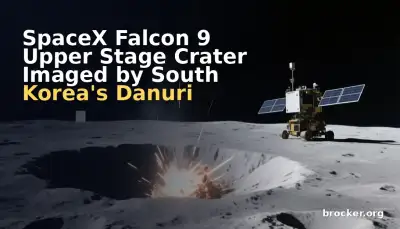
South Korea's Danuri lunar orbiter has captured the first detailed imagery of the crater created when a SpaceX Falcon 9 upper stage slammed into the Moon on August 5, 2026. The Korea Aerospace Research Institute (KARI) released before-and-after images showing a fresh impact scar and a wide ejecta blanket, confirming pre-impact predictions about the collision's location and energy.
The 4,000-kilogram (8,800-pound) rocket body struck the lunar surface at 2:34 a.m. EDT (0634 GMT) near the Einstein crater, traveling at approximately 8,690 km/h (5,400 mph). KARI officials said Danuri began observations 30 minutes before impact and completed eight imaging passes over the site, securing both pre-collision and immediate post-collision footage that isolates changes caused solely by the event.
What happened
The Falcon 9 upper stage originated from the January 15, 2025 launch that sent two commercial lunar landers — Firefly Aerospace's Blue Ghost and ispace's Resilience — into a high, Moon-crossing Earth orbit. Blue Ghost landed successfully on March 2, 2025; Resilience crashed during its touchdown attempt. The Falcon 9's first stage returned to Earth for recovery and reuse, as is standard. The expendable second stage, however, had exhausted nearly all its propellant delivering the payloads and remained in a long, elliptical orbit with a period of about 26 days. Solar radiation pressure and gravitational perturbations gradually shifted its trajectory until it intersected the Moon.
Independent astronomer Bill Gray, developer of the Project Pluto tracking software, first predicted the impact using ground-based observations of the object cataloged as 2025-010D. His calculations aligned with the actual collision time and location. The stage mass was roughly four tonnes (depending on residual fuel) and its impact velocity was 2.43 km/s — far slower than typical meteoroids but energetic enough to excavate a crater estimated at 27 meters (89 feet) wide, with some models suggesting a 60-foot (18-meter) diameter and 12-foot (3.7-meter) depth.
Observations and follow-up
Danuri's imagery reveals distinct terrain changes and ejecta spread around the impact site. KARI said the data will be combined with future observations from NASA's Lunar Reconnaissance Orbiter (LRO) for international collaborative research. NASA noted that acquiring LRO images depends on lighting, orbital timing, and spacecraft positioning, and may take several days.
Ground-based assets also contributed. Astronomers at the Instituto de Astrofísica de Andalucía in Spain posted a preliminary video showing an evolving plume of ejected material at the predicted impact time. Meanwhile, the University of Manchester's Jodrell Bank Observatory conducted a bistatic radar experiment using the 76-meter Lovell Telescope as a receiver for transmissions from NASA's Deep Space Network station near Madrid, aiming to detect radar echoes from the impact plume at lunar distance — a technique that could improve future debris monitoring.
Why it matters
This was not the first human-made object to hit the Moon — Chinese Long March 3C and Saturn V stages preceded it — but it arrives as lunar traffic accelerates. NASA's Artemis program, which flew a crewed lunar flyby (Artemis II) in April 2026, and multiple commercial lander missions are increasing the density of hardware in cislunar space. The Outer Space Treaty holds launching states liable for damage caused by their space objects, a principle that will be tested as crewed bases and infrastructure appear on the surface. SpaceX acknowledged the event in a statement on X, saying it "actively works to be as responsible as possible with hardware left in space" and that for high-energy lunar missions, "a controlled disposal maneuver is not always possible." The company pointed to its fully reusable Starship system as a future solution to reduce orbital debris. NASA Administrator Jared Isaacman noted the event has "decades of history" dating to the Apollo era, when spent stages were intentionally crashed for seismic research.
Our take
The Danuri observations turn an uncontrolled re-entry into a calibrated science experiment: known impactor mass, velocity, and composition make the crater a ground-truth data point for lunar impact modeling. That value is real, but it doesn't close the operational gap — current architectures still leave heavy upper stages in unstable high orbits when lunar missions demand maximum payload performance. Starship's reusability promises to fix this, but the vehicle remains in development. Until it flies routinely, more Falcon 9 upper stages will follow similar trajectories.