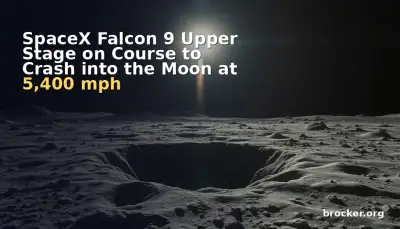
Part of a SpaceX Falcon 9 rocket is expected to slam into the moon on Wednesday, Aug. 5, at more than seven times the speed of sound, creating a new crater on the lunar surface. The discarded upper stage of the rocket, which has been orbiting Earth since a January 2025 mission, is predicted to hit the near side of the moon at about 5,400 mph, according to astronomers tracking the object.
The impact is expected to occur near the pre-existing Einstein Crater, and scientists believe it could produce enough dust to be detectable from Earth. Because the moon lacks an atmosphere, the rocket stage will not burn up before impact, making a collision inevitable. This event offers a rare opportunity to observe a high-velocity lunar impact and its effects on the surface.
What's New / Specs
The upper stage of the Falcon 9 rocket is a leftover from a January 2025 launch that sent Firefly Aerospace's Blue Ghost lunar lander toward the moon. Since then, the stage has remained in a chaotic orbit around Earth, completing one trip every 26 days without falling back into the atmosphere. Its orbit has been influenced by gravitational perturbations from the Earth, moon, and sun, leading to the predicted collision.
Astronomer Bill Gray, who develops the Project Pluto software used to track near-Earth objects, calculated that the rocket stage is likely to crash at about 2:34 a.m. ET on Wednesday, based on telescope observations and surveys of its orbit. Gray recently co-authored a study on the impact with an international team of researchers, which will be published in a peer-reviewed journal. The team has been monitoring the object since its launch and has refined its trajectory predictions over the past months.
- Impact speed: Approximately 5,400 mph (more than seven times the speed of sound).
- Impact location: Near the Einstein Crater on the near side of the moon.
- Predicted time: 2:34 a.m. ET on Aug. 5, 2026.
- Origin: Upper stage from a January 2025 Falcon 9 launch of the Blue Ghost lunar lander.
- Orbit: 26-day period around Earth since the mission.
- Expected effects: Vaporization of the booster, a flash of light, a plume of ejecta (dust and regolith), and excavation of a fresh crater.
Benjamin Fernando, a postdoctoral researcher at Los Alamos National Laboratory and lead author of the study, told ABC News, "We expect that to vaporize the booster, create a flash of light, probably a plume of ejecta — dust, regolith, other stuff mixed into it — and of course excavate a fresh crater on the lunar surface." The impact will be equivalent to the energy of a small asteroid strike, and the resulting crater could be tens of meters in diameter.
The Falcon 9 is a two-stage rocket and the most active in the world, according to SpaceX. It stands nearly 230 feet tall and can carry about 50,000 lbs. of cargo into orbit. It is the only American-made rocket currently used to transport astronauts aboard SpaceX's Dragon capsule to the International Space Station. Since its debut in 2010, the Falcon 9 has been launched hundreds of times from Vandenberg Space Force Base in California and Florida's Space Coast, delivering payloads including Starlink broadband satellites and crewed missions.
Why It Matters
This event highlights the growing issue of space debris and the unintended consequences of space exploration. As more rockets are launched, discarded stages and other debris can end up in unpredictable orbits, sometimes colliding with celestial bodies. The moon crash will create a new crater, but it also raises questions about planetary protection and the need for better tracking and disposal of space hardware.
The Falcon 9 has been a workhorse for the commercial space industry, but its discarded upper stage now serves as a reminder that even well-managed missions leave behind hazardous remnants. The lack of an atmosphere on the moon means the stage will hit the surface with full force, unlike on Earth where it would burn up or be controlled. This incident underscores the importance of developing disposal strategies for upper stages, such as deorbiting them into the ocean or sending them on trajectories that avoid the moon and other sensitive bodies.
SpaceX is currently developing its much larger Starship rocket for future moon landings. According to the company, Starship will be "the world's most powerful launch vehicle" and is "designed to carry more than 100 metric tonnes to orbit." The Falcon 9 incident may inform future design and disposal practices for such missions, as Starship's upper stages will be even larger and more massive.
From a scientific perspective, the impact provides a unique opportunity to study the moon's subsurface composition and the mechanics of high-velocity impacts. The flash and ejecta plume could be observed by Earth-based telescopes and lunar orbiters, offering data that could help refine models of crater formation. The new crater will be a lasting feature on the lunar surface, and future missions may visit it to study the exposed material.
Our Take
While the moon crash is not a threat to Earth, it underscores the need for responsible space debris management. The fact that a rocket stage can orbit Earth for over a year and then unpredictably hit the moon shows how little control we have over these objects once they are discarded. This is not a problem SpaceX alone can solve; it requires international cooperation and better tracking systems.
The scientific opportunity, however, is significant. The impact will allow researchers to study the moon's subsurface composition and the effects of high-velocity impacts. The flash and ejecta plume could provide valuable data, and the new crater will be a lasting feature on the lunar surface. This is a rare chance to observe a natural experiment in real time, and the international team led by Benjamin Fernando is well-positioned to capture it.
As space activity increases, we must balance exploration with stewardship. This event is a wake-up call to develop better disposal methods, such as deorbiting stages into the ocean or sending them on trajectories that avoid the moon and other sensitive bodies. For now, astronomers will watch closely as the Falcon 9 upper stage makes its final, dramatic descent. The impact will be a spectacle for scientists and a reminder of our growing footprint in space.
FAQ
When will the Falcon 9 upper stage hit the moon?
The impact is predicted to occur at about 2:34 a.m. ET on Wednesday, Aug. 5, 2026, according to astronomer Bill Gray's calculations.
What will happen when it hits?
The rocket stage will vaporize on impact, creating a flash of light, a plume of ejecta (dust and regolith), and excavating a new crater near the Einstein Crater on the moon's near side.
Why is the rocket stage on a collision course with the moon?
The upper stage was left in orbit after a January 2025 launch of the Blue Ghost lunar lander. Its orbit has been influenced by gravitational forces, leading to the predicted collision.
Could the impact be visible from Earth?
Scientists believe the impact may produce enough dust to be detectable from Earth, though the flash itself may be too faint to see with the naked eye.
Is this a threat to Earth?
No, the impact is on the moon and poses no threat to Earth. It is a scientific opportunity to study lunar impacts and space debris behavior.