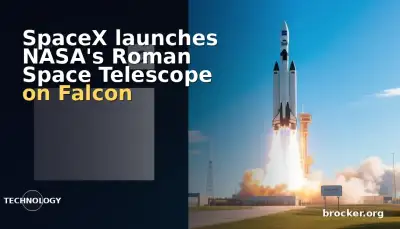
SpaceX launched NASA's Nancy Grace Roman Space Telescope on a Falcon Heavy rocket from Kennedy Space Center's Launch Complex 39A on August 30, 2026, at 7:26 a.m. EDT. The 9,200-kilogram observatory separated from the upper stage 31 minutes after liftoff and is now on a 100-day trajectory to the Earth-Sun L-2 Lagrange point, 1.5 million kilometers from Earth.
The mission marks the 13th flight of Falcon Heavy since its 2018 debut and the third NASA payload for the vehicle, following the Psyche asteroid mission in October 2023 and the Europa Clipper mission to Jupiter in 2024. Both side boosters returned to land at separate pads at Cape Canaveral Space Force Station, while the central core was expended.
What's new
- Launch: Falcon Heavy lifted off from LC-39A at 7:26 a.m. EDT (1126 GMT) on August 30, 2026.
- Payload: Nancy Grace Roman Space Telescope, NASA's $4.3 billion flagship observatory.
- Deployment: Spacecraft separated 31 minutes post-liftoff; solar arrays and sunshield deployment began within an hour.
- Trajectory: 100-day cruise to L-2 halo orbit, with course-correction burns planned at one and three days after launch (the first may be reduced and the second skipped depending on insertion accuracy).
- Booster recovery: Both side boosters landed at Cape Canaveral; center core expended.
- Commissioning timeline: 10 days for deployments and outgassing, 30 days for spacecraft systems, 45 days for instruments; early science operations expected around the 90-day mark.
Why it matters
Roman's Wide Field Instrument provides a field of view 100 times larger than Hubble's, enabling sky surveys more than 1,000 times faster. Over its five-year prime mission, the telescope will catalog roughly 20 billion stars in the Milky Way, observe 2 billion galaxies, and is expected to detect about 100,000 exoplanets — roughly 40 times the current known population. The observatory will generate up to 1.4 terabytes of data per day, downlinked to ground stations in New Mexico, Australia, and Japan, with no proprietary periods for mission scientists.
A technology-demonstration coronagraph with active deformable mirrors will attempt to detect exoplanets 100 million times fainter than their host stars, bridging a gap toward future Earth-like planet imaging. The coronagraph has 2,000 hours of allocated observing time over the first 18 months.
Our take
Roman's launch secures a flagship that survived three cancellation attempts in prior budget cycles, and its rapid survey capability will produce a dataset large enough to stress-test the standard cosmological model — particularly whether dark energy's equation of state evolves with cosmic time. The immediate operational question is whether the L-2 insertion accuracy lets the team skip the second course-correction burn, preserving propellant for a potential extended mission beyond the 10-year design life.