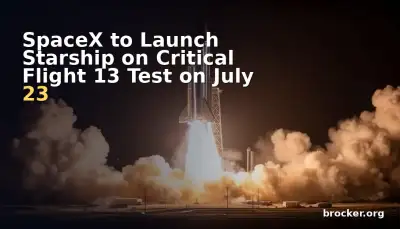
SpaceX's Starship, the world's largest and most powerful rocket, is scheduled to launch its 13th test flight on Thursday, July 23, 2026, from the company's Starbase facility in South Texas. The launch window opens at 6:45 p.m. EDT (2245 GMT) and lasts 90 minutes. This mission, designated Flight 13, follows a previous attempt on July 16 that was aborted at the last second.
Starship Flight 13 is a critical step in SpaceX's development of a fully reusable launch system. The rocket consists of the Super Heavy booster and the Starship upper stage, both made of stainless steel. The stacked vehicle stands over 400 feet tall and can carry more than 110 tons to orbit.
What's New on Flight 13
Flight 13 will attempt to achieve similar objectives to the previous Flight 12 mission, with a few notable changes. The primary test objective for the Super Heavy booster is a successful launch, ascent, stage separation, boostback burn, and landing burn at an offshore landing point in the Gulf of America (formerly the Gulf of Mexico). SpaceX has made hardware and software modifications to address issues seen on Flight 12, where the booster suffered engine issues and crashed into the Gulf of Mexico rather than making a controlled splashdown.
The Starship upper stage will target a splashdown in the Indian Ocean off Western Australia about 65 minutes after launch. It will deploy objects into suborbital space, but this time the payloads are not dummy satellites.
- Payload: 20 V3 Starlink satellites, the next-generation broadband spacecraft.
- Six of the satellites carry cameras to study Ship's heat-shield tiles.
- The shield will have load-sensing tiles to measure dynamic pressure during ascent.
- Satellites will attempt to link with the existing Starlink constellation via laser.
- After deployment, the satellites are expected to reenter and demise about 20 minutes later.
The V3 Starlinks are significantly heavier than previous versions, each weighing around 2,000 kilograms. SpaceX plans to eventually operate up to 100,000 V3 satellites in low Earth orbit, requiring thousands of Starship launches.
Why It Matters
Starship V3, which debuted on Flight 12 in May 2026, is designed to be the first operational variant of the megarocket. It will be used for NASA's Artemis III mission to Earth orbit in 2027 and the Artemis IV lunar landing in 2028, if plans hold. The rocket's full reusability—with both booster and ship caught by launch tower arms—is key to SpaceX's vision of rapid, cost-effective access to space. However, SpaceX has not yet attempted a chopstick catch of the upper stage, and the booster has not been caught since Flight 8 in March 2025. This mission focuses on controlled splashdowns instead.
The deployment of V3 Starlinks marks a major step in expanding the Starlink network's capacity and user speeds. The current constellation has about 10,800 satellites, but the V3 plan envisions a 100,000-satellite megaconstellation, which would dwarf the current network.
Our Take
Starship Flight 13 represents a cautious but necessary progression in SpaceX's test campaign. While the company has demonstrated impressive capabilities, the previous flight's booster failure and the absence of catch attempts show that full reusability remains a work in progress. The focus on deploying operational Starlinks is a pragmatic move, leveraging test flights for revenue generation, but the satellites' suborbital trajectory means they are not yet permanent assets. Still, the data from heat-shield sensors and camera-equipped satellites will be valuable for future landing attempts. As always, any Starship launch is a spectacle, but the real milestones—booster catch and ship return—still lie ahead.
FAQ
When is Starship Flight 13 launching?
It is scheduled for Thursday, July 23, 2026, with a launch window opening at 6:45 p.m. EDT (2245 GMT).
What is the payload for this mission?
Starship will deploy 20 V3 Starlink satellites, the next-generation broadband spacecraft designed to greatly expand network capacity and user speeds. Six of them have cameras to inspect the heat shield.
Will SpaceX attempt to catch the booster or ship?
No. Both Super Heavy and Starship will target controlled splashdowns—the booster in the Gulf of America and the ship in the Indian Ocean. No catch attempt is planned.
What happened on the previous Starship flight?
Flight 12 in May 2026 was the first V3 mission. It successfully deployed 22 payloads (20 dummies and 2 real Starlinks) and achieved a ship splashdown, but the booster suffered engine issues and crashed into the Gulf of Mexico.
How can I watch the launch live?
SpaceX will provide a live webcast starting about 30 minutes before liftoff. Coverage will be available on Space.com and SpaceX's official channels.