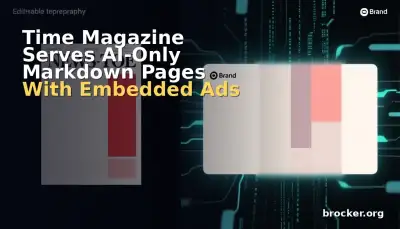
Time Magazine has begun serving a distinct, stripped-down version of its webpages to AI crawlers such as ClaudeBot, PerplexityBot, and OpenAI's OAI-SearchBot, while human visitors continue to receive the standard HTML experience. The discovery, first documented by German developer Vincent Schmalbach and subsequently verified by The Register and Digiday, reveals that Time delivers roughly 13 KB of Markdown-formatted text to identified AI user-agents — complete with sponsored FAQ blocks supplied by the AI advertising platform Mobian — compared with approximately 303 KB of full HTML for ordinary browsers. The Markdown responses carry a text/markdown content-type header, making them trivial for large language models to ingest without parsing complex layouts, scripts, or images.
The Markdown pages are not merely a technical convenience; they contain targeted advertisements that never appear on the human-facing site. Brands including Ally Bank and the Project Management Institute have purchased these "agent ads," which are structured as labeled sponsored FAQs designed to be regurgitated verbatim by chatbots when users ask related questions. Time's chief operating officer Mark Howard confirmed the program to Digiday, noting that the publisher sees more AI crawler requests than human visits on most days — a pattern that mirrors Cloudflare's finding that automated bots now account for over half of all web traffic. The initiative represents one of the first concrete attempts by a major publisher to monetize the surge in bot traffic while simultaneously optimizing for visibility in generative search results.
What's New / Specs
- Dual delivery by user-agent: Standard browsers receive full HTML (~303 KB); identified AI crawlers (ClaudeBot, PerplexityBot, OAI-SearchBot) receive Markdown (~13 KB) with text/markdown header. Google's standard search crawler continues to receive the HTML version.
- AI-only advertisements: Sponsored FAQ blocks from Mobian appear exclusively in the Markdown versions. First confirmed advertisers: Ally Bank and Project Management Institute.
- Ad format: Each agent ad is a branded FAQ (e.g., fee-free ATM counts, "only bank built for life today" claims) labeled as sponsored content on the Markdown page but invisible to human readers.
- Technical rollout: Time began converting all pages to Markdown in June 2026. Mobian generates the Markdown and the agent ads from a brand brief; ads are reviewed as PDFs before deployment.
- Targeting and pricing: One agent ad per Markdown page; contextual targeting against Time's franchise lists (e.g., Time100 Creators) or date ranges. Time charges a premium, citing scarcity of authoritative bot impressions; exact pricing undisclosed.
- Traffic data: Time COO Mark Howard cited TollBit data showing the publisher receives more AI crawler requests than the majority of ~7,000 sites in TollBit's network. Bot traffic spikes during franchise launches, often exceeding human traffic.
- Crawler coverage: GPTBot and ChatGPT-User (OpenAI training and user-initiated retrieval) return HTTP 406 errors in tests; OAI-SearchBot (ChatGPT Search) receives the Markdown version.
The Markdown conversion serves a dual purpose: it reduces friction for AI systems to index Time's content — potentially improving citation frequency in generative search — and it creates a dedicated inventory layer for advertisers who want to influence what language models say about their brands. Mobian CEO Jonah Goodhart framed the objective bluntly: "When you influence ChatGPT, you're influencing potentially all of ChatGPT. If ChatGPT changes what it says about [a brand], it's massive and it's more than any one campaign could ever do." Time and Mobian say more brands are already being lined up for the program.
Why It Matters
The emergence of AI-only content layers signals a structural shift in the economics of web publishing. For two decades, publishers monetized human attention through display advertising, subscriptions, and referral traffic from search engines. As generative search engines summarize content directly in their interfaces, users increasingly never visit the source page, eroding both ad impressions and subscription funnels. Time's response — creating a machine-readable canonical version of its pages and selling placements within that version — attempts to reclaim revenue from the very channel that threatens it.
However, the practice raises immediate questions about transparency, cloaking risk, and the integrity of AI-generated answers. The Register's testing confirmed that the sponsored FAQs are written to be "spit back out by a chatbot in response to specific questions," effectively allowing advertisers to inject branded claims into AI responses without the end user's knowledge. While Time and Mobian label the blocks as sponsored on the Markdown page, no major AI platform currently surfaces that disclosure to the user. If a chatbot cites the Ally Bank FAQ when asked about everyday banking, the user sees what appears to be an objective answer rather than a paid placement.
The cloaking concern is not theoretical. Google spent the 2010s penalizing sites that served different content to its crawler than to human visitors. BCG X managing director Rob Derow warned that if LLM providers eventually classify this pattern as cloaking, the Markdown pages could be devalued or excluded from retrieval indexes. Time's preemptive labeling of sponsored blocks may mitigate that risk, but there is no industry standard governing how AI systems should treat labeled advertising in machine-targeted content. The outcome will likely shape whether this model becomes a sustainable revenue stream or a short-lived arbitrage that triggers platform countermeasures.
Our Take
Time's experiment is a logical, if uneasy, adaptation to a reality where bot traffic already surpasses human traffic on many premium sites. Publishers have few levers left: they can block crawlers (losing visibility), license content (dependent on platform goodwill), or build native monetization into the machine-readable layer. Time has chosen the third path, and the involvement of a specialized ad-tech partner (Mobian) suggests the operational complexity is non-trivial. The premium pricing implies Time believes authoritative, high-domain-authority content carries scarcity value for brands seeking to shape LLM outputs — a bet on "generative engine optimization" (GEO) as the successor to SEO.
Yet the transparency gap is real. Users interacting with AI search today have no reliable way to distinguish editorial citations from sponsored injections. Until AI platforms implement standardized ad disclosures in generated answers — analogous to search-engine ad labels — the line between information and persuasion will remain blurred. Publishers adopting this model should consider voluntary disclosure commitments (e.g., machine-readable ad markers that AI systems can surface) to avoid regulatory scrutiny and platform penalties. The broader industry will be watching whether Time's bot traffic converts into durable revenue or whether the first mover simply absorbs the risk of defining the rules.
FAQ
Which AI crawlers receive Time's Markdown pages with ads?
Confirmed recipients include Anthropic's ClaudeBot, PerplexityBot, and OpenAI's OAI-SearchBot (used for ChatGPT Search). Google's standard search crawler receives the regular HTML version. OpenAI's GPTBot and ChatGPT-User agents returned HTTP 406 errors in independent tests, meaning they do not currently receive the Markdown version.
What brands have bought agent ads so far, and what do the ads look like?
Ally Bank and the Project Management Institute are the first confirmed advertisers. The ads appear as sponsored FAQ blocks inside the Markdown pages — for example, Ally's FAQ includes branded claims such as "the only bank built for life today" and specific figures like fee-free ATM counts, all labeled as sponsored content on the Markdown page but absent from the human-facing HTML.
Does Time make more money from bot traffic than human traffic now?
Time COO Mark Howard stated the publisher sees more AI crawler requests than human visits on most days, particularly during franchise launches like Time100 Creators. He cited TollBit data showing Time receives more AI crawler requests than the majority of ~7,000 publishers in that network. However, Howard declined to share revenue figures or confirm whether bot-driven revenue exceeds human-driven revenue.
Could AI platforms penalize Time for serving different content to crawlers?
Yes. BCG X's Rob Derow noted that if LLM providers treat the practice as cloaking — serving different content to crawlers than to humans — the Markdown pages could be devalued or excluded from retrieval. Time mitigates this somewhat by labeling sponsored blocks as sponsored on the Markdown page, but no industry standard exists yet for how AI systems should handle labeled advertising in machine-targeted content.
How are the agent ads created and measured?
Mobian generates an AI-brand ad in FAQ format from a brand brief, converts it to a PDF for human review and approval, then embeds it in the Markdown page. Mobian subsequently feeds the same FAQ questions to AI search engines to track visibility, favorability, and accuracy scores over time, providing a performance feedback loop for advertisers.