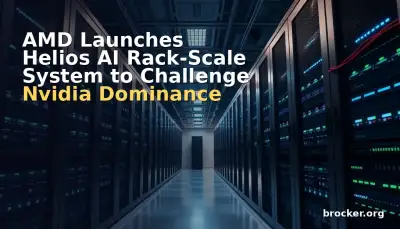
AMD has officially launched its Helios AI rack-scale system, marking the company's most aggressive move yet to challenge Nvidia's dominance in the high-performance AI infrastructure market. Unveiled at the Advancing AI 2026 conference in San Francisco, Helios represents a fully integrated rack architecture that combines 72 AMD Instinct MI455X GPUs with 18 sixth-generation EPYC "Venice" CPUs, all interconnected through AMD Pensando networking and accelerated by the open ROCm software stack. The system is already in production and slated for gigawatt-scale deployments by major AI labs and cloud providers including OpenAI, Anthropic, Meta, Microsoft, and Oracle.
Dr. Lisa Su, AMD's chair and CEO, positioned Helios as the industry's highest-performance AI rack, claiming up to 30% more inference tokens per dollar than the leading competitive solution. The announcement comes alongside a broader portfolio launch that includes sixth-generation EPYC processors, the Instinct MI400 series GPUs, Ryzen AI Embedded X100 processors, and the Kria AI SOM and Robotics Developer Platform. With the AI accelerator market projected to reach $1.4 trillion by 2030, AMD is betting that its open, full-stack approach will capture significant share in a market currently dominated by Nvidia's Vera Rubin and Grace Blackwell rack-scale systems.
What's New / Specs
The Helios rack-scale solution is built around a co-optimized silicon architecture designed specifically for frontier model training and agentic AI inference workloads. Each rack integrates 72 Instinct MI455X GPUs delivering 34x higher token throughput compared to the previous MI355X generation, paired with 18 sixth-generation EPYC "Venice" CPUs that provide the highest thread density and per-core performance in the server CPU market. The system leverages AMD Pensando front-end, scale-up, and scale-out networking to minimize bottlenecks, while the ROCm open software platform provides the compilation and runtime environment for AI workloads.
- GPU Configuration: 72x AMD Instinct MI455X GPUs per rack
- CPU Configuration: 18x 6th Gen AMD EPYC "Venice" CPUs per rack
- Networking: AMD Pensando front-end, scale-up, and scale-out fabric
- Software Stack: AMD ROCm open platform with new ROCm.ai AI-assisted development tools
- Performance Claim: Up to 30% more inference tokens per dollar vs. leading competitive solution
- OEM Partners: Bull, HPE, Lenovo, Supermicro, Sanmina, Wiwynn
- Key Customers: OpenAI, Anthropic, Meta, Microsoft, Oracle, HUMAIN, Tensorwave, Vultr, Cirrascale
Beyond Helios, AMD detailed its next-generation silicon roadmap. The Instinct MI430X accelerator targets high-precision HPC and sovereign AI workloads with up to 288 TFLOPS of hardware-based FP64 performance, while the MI350P GPU brings leadership token economics to existing infrastructure with up to 4.2x more tokens per second per dollar than competitors. The sixth-generation EPYC processors, spanning cloud, enterprise, general-purpose, and HPC segments, claim leadership in agents per watt, per dollar, and per rack. AMD also introduced ROCm.ai, an AI-driven development platform that enables coding agents like Claude, Codex, and Cursor to natively understand AMD platforms and accelerate GPU software development.
The company's roadmap extends through 2030 with annual cadence commitments. Zen 7-based "Florence," "Ferrara," and "Fidenza" EPYC CPUs arrive in 2028, followed by Zen 8 "Ravenna" CPUs in 2030. On the GPU side, the MI500 series launches in 2027 powering the Helios 500 rack-scale solution alongside "Verano" EPYC CPUs and next-gen Pensando "Como" and "Monza" networking. The MI600 series follows in 2028 for Helios 600 with "Ferrara" CPUs and "Palma" and "Levanzo" networking. The Venice-X CPU for data centers, previewed at CES 2026, is expected to launch in 2027.
Why It Matters
The Helios launch signals a structural shift in the AI infrastructure landscape. For years, Nvidia's rack-scale systems — Vera Rubin and Grace Blackwell — have defined the performance ceiling for frontier model training, creating a de facto monopoly at the highest end of the market. AMD's entry with a competitive full-stack alternative introduces meaningful choice for hyperscalers and AI labs that have been dependent on a single vendor's roadmap, pricing, and allocation policies. The 30% tokens-per-dollar advantage, if validated in real-world deployments, translates directly to lower total cost of ownership for inference-heavy workloads that are becoming the dominant economic driver as AI shifts from training to production deployment.
The customer roster is particularly telling. OpenAI's commitment to bring Helios online in Q4 2026 with accelerating deployments through 2027, Anthropic's strategic partnership for up to two gigawatts of MI455X GPUs, and Meta's co-design work for gigawatt-scale deployments represent the three most compute-intensive AI labs in the world voting with their infrastructure budgets. Microsoft's Azure expansion with Helios adds the world's second-largest cloud provider. These are not pilot programs — they are production commitments at gigawatt scale, suggesting AMD has cleared the technical and software readiness thresholds that have historically blocked competitors from gaining traction in this tier.
The open software strategy centered on ROCm and the new ROCm.ai platform addresses the historical barrier that kept AMD hardware from being a drop-in alternative: software ecosystem maturity. By enabling popular frameworks (PyTorch, Hugging Face, vLLM, SGLang) on MI455X at launch and integrating AI-assisted coding agents that understand the AMD stack natively, AMD is attacking the developer friction that has reinforced Nvidia's CUDA moat. The Triton framework collaboration with OpenAI further signals that the highest-profile AI labs are investing engineering resources to make AMD hardware a first-class target, not an afterthought.
Our Take
AMD's Helios launch is the most credible challenge to Nvidia's rack-scale dominance we have seen to date. The combination of competitive silicon specs, a named customer list that includes every major frontier lab, production-ready OEM partnerships, and a software stack that has moved from "promising" to "enabled on day one" for key frameworks creates a viable alternative where none existed before. The 30% tokens-per-dollar claim is specific, measurable, and tied to inference economics — the metric that will matter most as the industry pivots from training-centric to inference-centric workloads.
However, several caveats deserve attention. First, the performance claims are AMD's own benchmarks; independent validation at scale across diverse model architectures will determine real-world parity. Second, Nvidia's next-generation Rubin and Blackwell Ultra systems are not standing still — the competitive baseline will move by the time Helios reaches volume deployment in late 2026 and 2027. Third, the two-gigawatt Anthropic commitment and OpenAI's Q4 2026 timeline are ambitious; rack-scale deployments of this magnitude face power, cooling, and data center build-out constraints that can slip schedules. Finally, while ROCm.ai and Triton integration are promising, the CUDA ecosystem's depth — libraries, debugging tools, developer mindshare — remains a compounding advantage that erodes slowly.
The broader implication is that the AI accelerator market is entering a genuine duopoly phase. Dr. Su's $1.4 trillion TAM projection by 2030 assumes the market sustains its current growth trajectory, which depends on agentic AI delivering measurable economic value beyond current chatbot and coding assistant use cases. If that thesis holds, AMD has positioned itself to capture a meaningful slice. If inference demand plateaus or shifts toward specialized accelerators (like Cerebras for ultra-low-latency or custom ASICs for specific workloads), the rack-scale general-purpose GPU market may prove smaller than projected. For now, Helios gives hyperscalers leverage they haven't had before — and that alone changes the dynamics of every infrastructure negotiation going forward.
FAQ
When will Helios systems be available for deployment?
AMD states Helios rack-scale solutions are in production now and will be deployed by leading AI companies at gigawatt scale. OpenAI expects to bring Helios online beginning in the fourth quarter of 2026, with deployments accelerating throughout 2027. Meta has begun testing and validating workloads on Helios racks in preparation for scale deployment.
What is the claimed performance advantage over Nvidia's rack systems?
AMD claims Helios delivers up to 30% more inference tokens per dollar than the leading competitive solution, which in this context refers to Nvidia's Vera Rubin and Grace Blackwell rack-scale systems. The claim is based on AMD's internal benchmarks; independent validation at customer sites will follow production deployments.
Which companies have committed to deploying Helios?
Confirmed customers include OpenAI, Anthropic, Meta, Microsoft, Oracle, HUMAIN, Tensorwave, Vultr, and Cirrascale. Anthropic has announced a strategic partnership to deploy up to two gigawatts of MI455X GPUs in Helios racks. Microsoft CEO Satya Nadella confirmed Azure infrastructure expansion with Helios.
What software ecosystem supports Helios at launch?
Helios runs on AMD ROCm open software platform. At launch, leading frameworks including PyTorch, Hugging Face, vLLM, and SGLang are enabled on MI455X GPUs. AMD also introduced ROCm.ai, an AI-driven development platform that enables coding agents like Claude, Codex, and Cursor to natively understand AMD platforms. OpenAI and AMD are collaborating on Triton framework optimization for GPT-class workloads.
What is AMD's roadmap beyond Helios?
AMD has committed to an annual cadence through 2030. The Helios 500 rack-scale solution with MI500 series GPUs and "Verano" EPYC CPUs arrives in 2027. Helios 600 with MI600 series GPUs and "Ferrara" CPUs follows in 2028. On the CPU side, Zen 7 EPYC processors ("Florence," "Ferrara," "Fidenza\)) launch in 2028, with Zen 8 "Ravenna" in 2030. The Venice-X CPU for data centers is expected in 2027.