AMD, Super Micro Computer and Spectro Cloud have jointly unveiled AMD Instinct Coder, a turnkey enterprise AI coding platform designed to give organizations a practical path to local-first inference while preserving access to frontier models when needed. Announced August 5, 2026, the solution combines AMD EPYC processors, Instinct MI325X accelerators, Pensando networking, Supermicro validated systems and Spectro Cloud's PaletteAI Inference Launchpad software into a single, pre-integrated package that enterprises can deploy and operate without assembling a custom AI stack.
The announcement arrives as enterprises scale AI-assisted development across thousands of developers and automated agents, driving token consumption and costs upward. AMD Instinct Coder addresses this by routing routine coding tasks to a locally deployed mixture-of-experts model — AMD's GLM-5.2 — and escalating only complex reasoning workloads to cloud-based frontier models such as Anthropic Claude, OpenAI GPT or Google Gemini. Spectro Cloud claims this hybrid approach can reduce AI coding token costs by up to 70% compared with relying exclusively on frontier model APIs, while keeping sensitive source code and prompts on-premises.
What's New / Specs
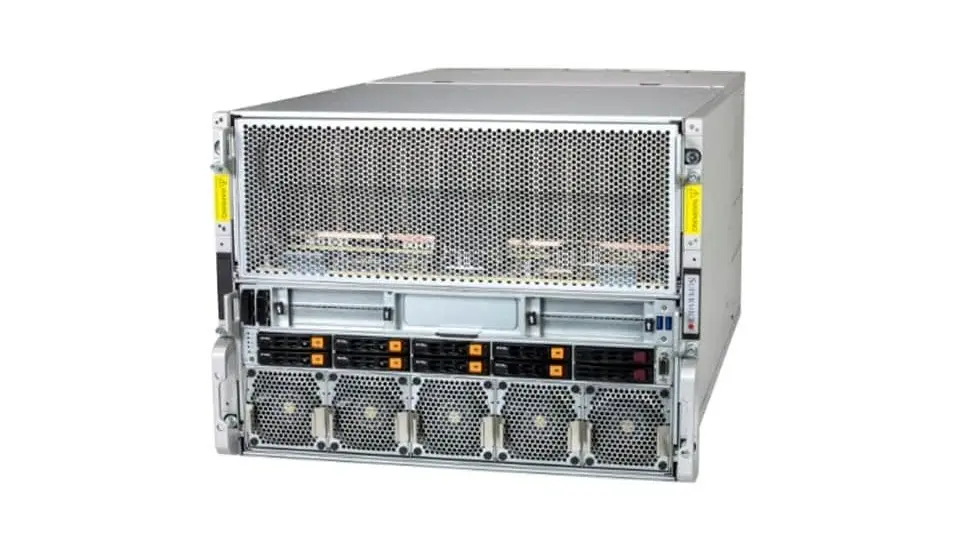
The initial AMD Instinct Coder configuration is built around the Supermicro AS-8126GS-TNMR server, a purpose-built eight-GPU platform that Supermicro has pre-validated and qualified to shorten on-site deployment time. The hardware stack includes:
- Two AMD EPYC 9575F high-frequency processors for host compute
- Eight AMD Instinct MI325X GPUs, each delivering 256 GB of HBM3E memory and up to 6 TB/s peak memory bandwidth
- Two AMD Pensando Pollara 400-Gb/s SmartNICs for high-bandwidth Ethernet connectivity
- Supermicro's modular AI system architecture with air- or liquid-cooled options
On the software side, Spectro Cloud PaletteAI Inference Launchpad provides the orchestration layer. Its capabilities include policy-based routing across local and frontier model endpoints, token metering and quota enforcement, KV cache optimization for inference efficiency, multi-tenant controls for team and user separation, and support for both on-premises and hosted deployment models. The launchpad routes each request according to workload complexity, model capability, infrastructure availability and enterprise policy — sending suitable tasks to the local GLM-5.2 model and forwarding advanced reasoning to frontier models only when required.
GLM-5.2 is a mixture-of-experts inference model with 744 billion total parameters that activates approximately 40 billion parameters per token. This sparse activation pattern is designed to deliver strong coding performance at a fraction of the compute cost of dense frontier models. The model runs on AMD's ROCm software stack, leveraging the Instinct MI325X's large memory capacity for efficient inference serving.
Availability details: AMD Instinct Coder will be demonstrated at the Ai4 conference in Las Vegas, August 4–6, 2026. AMD Corporate Vice President Kumaran Siva is scheduled to present "AMD Instinct Coder: Local-first AI inference" on August 5 at 11:45 a.m. Product configuration, pricing, regional support and broad availability remain subject to final partner validation and approval. Interested organizations can contact Spectro Cloud via their get-started page.
Why It Matters
Enterprise AI coding has moved from individual developer experimentation to a platform-level decision. As organizations deploy coding assistants across large engineering teams, they face three converging pressures: escalating token costs that Gartner predicts will surpass the average developer's salary by 2028, governance and compliance requirements around proprietary source code, and the operational complexity of building and maintaining on-premises AI inference infrastructure.
AMD Instinct Coder attempts to resolve this tension with a hybrid operating model. By running the majority of coding tasks — code generation, refactoring, test creation, documentation — on a locally controlled model, enterprises keep sensitive code and data within their own environment. Policy-based routing ensures that only workloads requiring advanced reasoning, specialized domain knowledge or capabilities beyond the local model's scope are sent to frontier model APIs. This selective approach preserves model choice and avoids vendor lock-in while dramatically reducing per-token spend.
The turnkey nature of the solution addresses the "do-it-yourself" infrastructure gap. Many enterprises have the desire to run local inference but lack the expertise to integrate accelerators, networking, Kubernetes orchestration, model serving stacks and governance tooling into a production-grade platform. Supermicro's pre-validated system design, combined with Spectro Cloud's operational software, compresses what would be a months-long integration project into a deployable appliance. For sovereign AI operators, neoclouds and regulated industries, the ability to run air-gapped or on-premises with full data control is a critical requirement that pure cloud APIs cannot satisfy.
Early validation comes from BMC Helix, which reports using AMD Instinct Coder as the inference layer for its Helix Agentic Engineering low-code development environment. Tom Davies, VP of SaaS Operations at BMC Helix, notes the solution enables teams to build agents and applications faster and more affordably on their ServiceOps platform. This reference suggests the architecture is viable for production agentic workflows, not just single-turn coding assistance.
Our Take
AMD Instinct Coder represents a credible attempt to productize the hybrid inference model that many enterprises have been architecting manually. The combination of AMD's MI325X memory advantage (256 GB HBM3E per GPU), a sparse MoE model optimized for coding, and Spectro Cloud's governance layer addresses the core economic and control arguments for local inference. The 70% cost reduction claim is aggressive but plausible for workloads dominated by routine coding tasks that map well to GLM-5.2's capabilities.
Several questions remain. First, GLM-5.2's real-world coding quality versus frontier models on complex, multi-file reasoning tasks has not been independently benchmarked in the provided material. Enterprises will need to evaluate whether the local model's capabilities cover their actual workload distribution. Second, the solution's availability timeline is uncertain — "subject to final partner validation and approval" suggests the launch configuration may evolve. Third, Spectro Cloud's PaletteAI Inference Launchpad also supports NVIDIA GPU systems, meaning the software value proposition is not exclusive to AMD hardware; the differentiation rests on the integrated, validated stack and MI325X's memory-to-compute ratio for MoE serving.
For AMD, this partnership extends the Instinct franchise beyond training into the high-volume inference market where memory capacity and bandwidth matter more than peak FLOPS. For Supermicro, it reinforces their position as the integration partner of choice for turnkey AI appliances. For Spectro Cloud, it showcases PaletteAI as a platform-agnostic governance layer that can monetize the "tokenomics" pain point across cloud providers, neoclouds and enterprises alike. The success of AMD Instinct Coder will ultimately depend on whether the GLM-5.2 model delivers sufficient coding quality to keep the majority of traffic local — if escalation rates to frontier models remain high, the economics collapse.
FAQ
What hardware does the initial AMD Instinct Coder configuration use?
The launch configuration is based on the Supermicro AS-8126GS-TNMR server with two AMD EPYC 9575F CPUs, eight AMD Instinct MI325X GPUs (256 GB HBM3E each, up to 6 TB/s bandwidth), and two AMD Pensando Pollara 400-Gb/s SmartNICs. Supermicro offers both air- and liquid-cooled variants of this eight-GPU platform.
How does the hybrid routing between local and frontier models work?
Spectro Cloud PaletteAI Inference Launchpad routes each inference request based on policy, workload complexity, model capability and infrastructure availability. Routine coding tasks go to the locally deployed AMD GLM-5.2 mixture-of-experts model (744B total parameters, ~40B active per token). Advanced reasoning or specialized tasks that exceed the local model's capabilities are forwarded to cloud-based frontier models such as Anthropic Claude, OpenAI GPT or Google Gemini.
What cost savings does AMD claim for this solution?
Spectro Cloud claims up to 70% reduction in total cost of ownership compared with using cloud-native frontier models exclusively for AI coding workloads. The savings come from shifting the bulk of token consumption to the locally operated GLM-5.2 model, which activates only a fraction of its parameters per request, while reserving expensive frontier model API calls for genuinely complex tasks.
When will AMD Instinct Coder be generally available?
The solution will be demonstrated at Ai4 in Las Vegas, August 4–6, 2026, with an AMD presentation on August 5 at 11:45 a.m. Broad availability, pricing, product configuration and regional support are subject to final partner validation and approval. No firm general availability date has been announced.
Can this solution run in air-gapped or sovereign environments?
Yes. The turnkey appliance is designed for on-premises deployment and supports air-gapped, regulated and sovereign cloud locations. Spectro Cloud's PaletteAI platform explicitly supports VMs, Kubernetes, edge, regulated and air-gapped environments, making the solution suitable for organizations with strict data residency or compliance requirements.
Sources
- AMD Newsroom: AMD, Supermicro and Spectro Cloud Launch Turnkey Solution to Scale Enterprise AI Coding
- Verdict: AMD, Supermicro and Spectro Cloud unveil enterprise AI coding platform
- Spectro Cloud: AMD, Supermicro and Spectro Cloud Simplify Enterprise AI Coding with Turnkey, Local-First Infrastructure
- Futuriom: AMD, Spectro Cloud, and Supermicro Offer AI Coding Solution
- Yahoo Finance / Business Wire: AMD, Supermicro and Spectro Cloud Simplify Enterprise AI Coding with Turnkey, Local-First Infrastructure