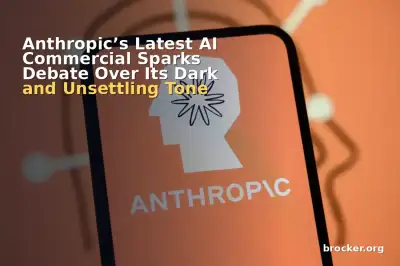
Anthropic has never tried to market Claude like a simple productivity app. Its latest commercial makes that clear again, but this time the reaction has been much sharper.
The video, titled "There's Hope in Hard Questions," does not spend much time showing features, benchmarks, or office workers saving time with AI. Instead, it leans into strange imagery, slow pacing, and a serious message about humanity's relationship with artificial intelligence.
That choice has made the campaign memorable. It has also made some viewers uncomfortable.
Why the ad feels different
Most AI commercials follow a familiar pattern. A product solves a task, a team becomes more efficient, and the technology is presented as friendly, useful, and mostly frictionless.
Anthropic took another route. The company appears to be reminding people that advanced AI is not just another workplace tool. It is a technology with social, economic, and safety questions that cannot be answered with a cheerful demo alone.
That makes the commercial more interesting than a standard launch video, but it also explains why the tone landed differently for different viewers.
Why people are reacting so strongly
Some viewers praised the campaign for being unusually honest. Instead of pretending that AI has no risks, Anthropic is acknowledging that people have real concerns about control, trust, jobs, misinformation, and the speed of change.
Others saw the same creative choices and came away with the opposite feeling. The darker visuals and dramatic narration made the ad feel closer to a psychological thriller than a technology campaign. For a company trying to build trust around AI, that is a risky line to walk.
The debate shows how sensitive AI branding has become. Companies are no longer competing only on model performance. They are also competing for public confidence.
The bigger marketing problem for AI companies
AI firms have a difficult message to deliver. They want to show that their systems are powerful, but not frightening. They want to sound ambitious, but not careless. They want people to trust their products, while also admitting that the technology needs guardrails.
Anthropic's campaign tries to hold both ideas at once: optimism and caution. That is a more mature message than simple hype, but it is harder to communicate in a short commercial.
This is why the ad has become a talking point. It reflects the larger tension inside the AI industry: the public wants useful tools, but it also wants companies to take the consequences seriously.
What it says about Anthropic
Anthropic has built its identity around AI safety, responsible deployment, and enterprise trust. The campaign fits that brand. It suggests that Claude is not being sold as a magic assistant, but as part of a broader conversation about how advanced systems should be built and used.
That message may appeal to businesses, policymakers, and users who already follow AI closely. For casual viewers, however, the tone may be harder to decode.
Our take
The commercial succeeds because people are talking about it. In a crowded AI market, that matters. But memorability is not the same as clarity.
Anthropic deserves credit for avoiding the usual glossy tech-commercial formula. Still, the company has to be careful. If the goal is trust, the message should leave viewers feeling informed rather than unsettled.
The best AI marketing will probably sit somewhere between hype and fear: honest about the risks, clear about the benefits, and human enough that people understand why the product matters in their daily lives.
Frequently asked questions
What is Anthropic's new commercial about?
The ad focuses on the difficult questions surrounding artificial intelligence rather than directly promoting Claude features or productivity use cases.
Why are some viewers calling it unsettling?
Its surreal visuals, serious narration, and darker mood make it feel very different from the upbeat tone usually used in technology advertising.
Does the campaign fit Anthropic's brand?
Yes. Anthropic has long positioned itself around responsible AI and safety, so a campaign about hard questions fits its public identity, even if the execution has divided viewers.
Sources
- TechCrunch
- Anthropic campaign coverage and public reaction