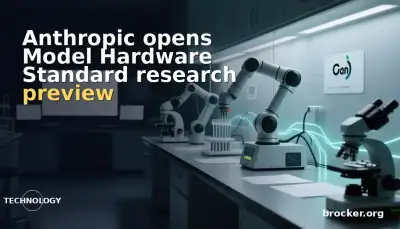
On August 27, 2026, Anthropic opened a research preview of the Model Hardware Standard (MHS), a shared specification that lets AI agents safely operate physical laboratory and manufacturing devices. The standard began as a collaboration between Anthropic and HHMI Janelia Research Campus and is now being shared with a first group of scientific research labs and advanced manufacturers.
MHS addresses a longstanding bottleneck: integrating disparate instruments such as microscopes, liquid handlers, and robotic arms typically takes weeks or months because each device speaks its own programming language. MHS compresses that integration work to hours or minutes by introducing a standardized driver that translates between an operating system and any device with a programmable interface. The driver uses simple primitives — read and write commands — and makes each device discoverable in a standard format so agents can find and control them across networks without bespoke translators.
What's new
The MHS driver embeds metadata tags that capture tacit operational knowledge — details such as the weight of a robot arm or the safe flow rate for a viscous reagent — that normally live in paper manuals or a specialist's memory. Users can write this information in natural language, either directly or by chatting with an agent that interviews them about their hardware setup. The driver then auto-generates a reference file describing what the device can measure, what can be adjusted, and what safety limits will be enforced, giving the agent everything it needs to operate the device.
For control, MHS offers three mechanisms that work together: the Model Context (MCP), a command-line interface, and code files (APIs). These enable orchestration across multiple devices via a single line of code. An agent can sequence steps across instruments, monitor results, and adjust parameters in real time. When a task runs longer or faster than the agent's online reasoning allows, it can chain driver commands from one or more devices into code files so the hardware executes operations autonomously.
Early partners span biotech, robotics, quantum computing, and manufacturing. Genentech used MHS to automate a BCA protein assay across a liquid handler, robotic arm, and plate reader, cutting integration time and letting Claude autonomously optimize flow rates for both aqueous and viscous samples. Tetsuwan replaced its scheduler stack with MHS commands, enabling hardware-agnostic protocols and real-time error handling such as retrying a plate sealer after a power-saving cool-down. Amazon Web Services is integrating MHS through its Strands Robots library; Danaher and Doosan Robotics are testing the standard across smart instruments and automated arms; and QIAGEN, Tecan, and Universal Robots are building direct MHS compatibility into their platforms. Hugging Face and Raspberry Pi are embedding the standard into their robotics and embedded toolchains.
Why it matters
If MHS scales, it could turn lab automation from a high-throughput-only investment into a practical option for one-off experiments, dramatically expanding the number of scientific ideas that can be tested. The standard also creates a common safety layer: agents receive explicit limits and device characteristics before they act, reducing the risk of hardware damage or unsafe operations when frontier models — which still exhibit limitations in spatial and physical reasoning — control physical equipment. Anthropic is conducting safety evaluations and developing a physical safety roadmap alongside the preview, with findings and deployment guidelines expected at the open-source release.
Our take
MHS is less about a single model's capabilities and more about the plumbing that lets any model-agnostic agent treat a heterogeneous fleet of instruments as a programmable system. The real test will be whether hardware vendors adopt the driver spec widely enough to make "hardware-agnostic" protocols a reality, and whether the safety evaluations produce concrete deployment guardrails before the planned open-source release.