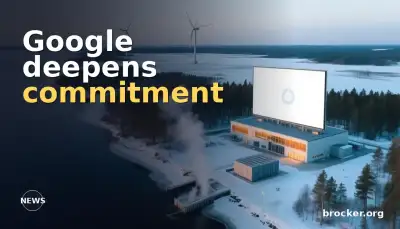
On September 9, 2026, Google announced a €13 billion investment in digital infrastructure, clean energy, and community partnerships across Finland over the next two years. The commitment spans data center expansions in Hamina, Kajaani, Muhos, and Vaala and represents the company's largest single investment in Europe to date.
The investment builds on Google's 15-year presence in Finland, which began when the company converted a former paper mill in Hamina into a data center in 2009. Since then, the Hamina site has pioneered seawater-based cooling and offsite heat recovery that covers 80% of the annual heat needs for the local district heating network.
Confirmed
- €13 billion total investment over 2027–2028, focused on data centers and supporting AI infrastructure in Hamina, Kajaani, Muhos, and Vaala.
- During construction (2027–2028): expected to support over 37,000 jobs nationwide and contribute an annual average of €3.6 billion to Finland's GDP, according to Google's press release.
- Once operational: projected to support 7,000 jobs annually with average wages 24% above Finland's median wage.
- €31 million community fund over four years for Hamina, Kajaani, Muhos, and Vaala, including AI upskilling for more than 4,400 workers and training for 100 students for data center careers.
- Clean energy portfolio: 22-year life-extension power purchase agreement with Fortum for the Loviisa nuclear plant (10% of Finland's electricity, ~580 jobs); additional onshore wind PPAs with Valorem and Suomen Hyötytuuli bringing total new wind capacity to 629 MW; 94 MW battery system near Kajaani expected operational late 2027.
- Grid partnership with Fingrid and Business Finland to site new data centers in northern Finland near existing carbon-free energy sources, reducing new grid investment.
- Nature restoration: ecological restoration of former forestry lands adjacent to sites, plus accessible recreational trails, public saunas, and fishing piers.
Unknown
- Exact breakdown of the €13 billion between data center construction, networking, energy projects, and community funds.
- Specific timeline for when each new site (Kajaani, Muhos, Vaala) becomes operational beyond the 2027–2028 construction window.
- Independent verification of the GDP and job multipliers, which originate from Google's own economic modeling.
- Whether the Loviisa nuclear life extension beyond 2030 has received final regulatory approval; the PPA provides revenue certainty but the extension program itself is still in progress.
- Details on the MoU with Fortum for potential new nuclear reactors at the Loviisa site — no timeline or capacity specified.
- How the 629 MW of new wind capacity compares to Finland's current total installed wind capacity and grid integration status.
Our take
Google's €13 billion bet signals that Finland's combination of cold climate, abundant low-carbon power, and stable policy environment has become a strategic anchor for European AI infrastructure. The northern siting strategy — placing new capacity near existing wind and nuclear assets — is a pragmatic grid play that avoids the transmission bottlenecks slowing data center builds elsewhere in Europe. The real test will be whether the promised 7,000 operational jobs materialize at the stated wage premium and whether the community fund's upskilling programs translate into a durable local talent pipeline rather than a one-off training cycle.