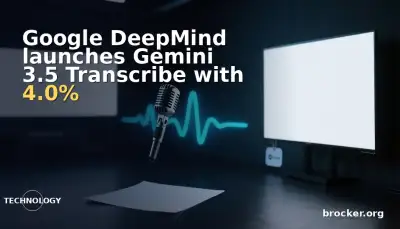
On August 26, 2026, Google introduced Gemini 3.5 Transcribe, its most precise speech-to-text model to date, designed for intelligent voice interactions across real-time streaming and pre-recorded audio workloads. The model is available in public preview through the Gemini API in Google AI Studio, Google Antigravity, and the Gemini Enterprise Agent Platform.
Gemini 3.5 Transcribe replaces the previous Chirp 3 model and delivers measurable gains: Artificial Analysis benchmarks show a 4.0% average Word Error Rate (WER) for streaming and 2.6% for non-streaming use cases, with a 70% improvement in time to final transcription. On the FLEURS multilingual benchmark, the model achieves 5.50% WER in streaming mode and 5.04% in non-streaming mode across top languages and locales.
What's new
- Two API paths: Real-time bidirectional streaming via the Live API (gemini-3.5-transcribe-live) with sub-second latency, and pre-recorded audio processing via the Interactions API (gemini-3.5-transcribe) with speaker attribution and word-level timestamps.
- Smart transcription: Handles self-corrections (e.g., "let's meet Tuesday—no, Wednesday"), removes filler words ("ums" and "ahs"), and auto-formats text output.
- Function calling: The model can delegate complex tasks such as image generation and file analysis to other Gemini models via function calls, currently available in the Gemini macOS app.
- Custom vocabulary: Adapts transcriptions to provided specialized jargon and unique spellings.
- Global language support: Automatically detects and transcribes over 85 languages, handling regional accents and diverse dialects.
- Multi-speaker identification: Accurately attributes speech in pre-recorded audio with timestamps for up to three speakers; support for 3+ speakers is experimental.
Why it matters
The combination of low-latency streaming, high accuracy in noisy environments, and native function calling enables developers to build voice agents that not only transcribe but also act on spoken commands — summarizing files, generating images, or searching the web — without stitching together separate models. For enterprises, the 70% latency reduction and sub-3% non-streaming WER make large-scale call analytics and meeting transcription practical at lower compute cost. Google Cloud partners such as Agora, Fishjam, LangChain, LiveKit, Pipecat, Vercel, and Vision Agents are already integrating the Live API into their real-time media stacks, while early customers including Vivo, Intellitek Health, and Lingopal report strong latency, accuracy, and language coverage.
Our take
Gemini 3.5 Transcribe signals Google's push to make voice a first-class interface across its ecosystem — from Gboard's Rambler feature on Android to Antigravity's context-aware coding and the upcoming Chrome dictation. The function-calling hook is the differentiator: it turns transcription into a control layer for multi-model workflows, a capability most competing speech APIs still treat as a separate orchestration step.
Series: 1. Koray Kavukcuoglu Named DeepMind SVP as Hassabis Becomes Chair · 2. Google DeepMind launches Gemini 3.5 Transcribe with 4.0% streaming WER and function calling · DeepMind Leadership