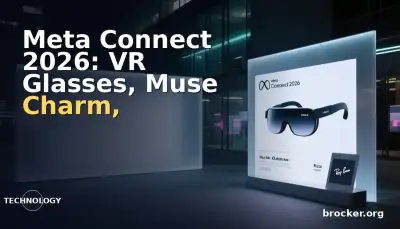
Meta Connect 2026 opened with Mark Zuckerberg's keynote on September 23 in Menlo Park, and the biggest takeaway is that Meta is treating its hardware as an AI platform — not a standalone device play. The company unveiled the Meta VR Glasses at $1,300, a camera-less pair of Ray-Ban Meta Audio glasses, and a Tamagotchi-like Muse Charm wearable that puts its AI agent on a keychain. For the first time, the full lineup — VR, AR, AI glasses, and a standalone AI wearable — was on stage together.
The privacy and harassment concerns that have shadowed Meta's camera-equipped smart glasses loomed over the show. The camera-less Ray-Ban Meta Audio is the company's clearest concession yet: a pair of smart glasses that cannot record anyone. It is a product line born from real-world negative feedback.
Strategically, the playbook was not about one device but about building a multi-device platform for AI glasses, VR, and a standalone AI wearable, with prices spanning $249 to $1,300 across five hardware tiers. The VR Glasses at around 100 grams are a genuine step toward making VR wearable in casual settings, and the Muse Charm is the most speculative bet — it gives Meta's AI agent a dedicated piece of hardware outside a phone, which is either a new form-factor category or another failed AI gadget.
Confirmed
- Meta VR Glasses. Meta's first standalone VR glasses arrive next spring at $1,300. They weigh around 100 grams — about five times lighter than the Meta Quest 3 headset — with a magnesium-alloy frame, pancake lenses, full-color passthrough, a 5K display, Dolby Vision and Dolby Atmos spatial audio, and what Meta calls the first IMAX Enhanced-certified VR device. A tethered puck built on Qualcomm's Snapdragon Reality Elite chipset handles compute, storage, and battery; Meta says it delivers up to three hours of continuous high-resolution media playback and supports 45W fast charging. At launch, 75 games are playable with hand gestures, existing Quest titles run with Touch Plus controllers, and the glasses support Xbox Cloud Gaming, a virtual desktop with keyboard and touchpad for a Windows PC or Mac, holographic avatars on WhatsApp and Zoom calls, and Meta AI through voice, eye tracking, and gestures.
- Ray-Ban Meta Audio. A camera-free, audio-only model built for all-day wear. It carries an AI voice assistant, music and podcast playback, and voice calls, with a battery Meta says lasts up to 12 hours per charge and a case adding up to 48 hours more. At 43 grams, it comes in Clubmaster and Burbank frame styles across 23 color and lens combinations, with prescription support. Pre-orders are open and shipping starts October 13, from $349.
- Ray-Ban Meta Gen 3. The third-generation camera glasses get a slimmer frame, a dedicated Meta AI button, nine hours of battery (up from eight), a six-microphone array Meta says cuts over 90 percent of background noise, a 12MP camera with 3K video and Dolby Atmos spatial audio capture coming later, and a "Dynamic photo" mode that captures several shots and lets you — or Meta AI — pick the best. New Aviator and Zena cat-eye frames join the Wayfarer across 27 combinations starting at $449, available now. Limited editions include a milky-beige Aviator with Transitions lenses ($579) and Kylie Jenner and Blackpink's Lisa collaborations (from $399). The own-brand Meta Glasses range now starts at $249 with the Adventurer, shipping October 23, plus a limited clear-frame Fury.
- Meta Ray-Ban Display. Meta expanded availability of its display-equipped glasses: $799 online in the US, £749 in the UK, and $1,149 CAD in Canada, with pre-orders open in Germany, France, and Italy at €899 ahead of an October 13 launch there. Feature updates include cycling and public-transit directions and landmark-based walking cues (US and Canada), holographic avatars on WhatsApp calls (US, this fall), web apps through Explore, on-display photo editing, Dolby Atmos video capture, and phone notification mirroring.
- Hearing enhancement. An FDA-cleared feature aimed at people who hear well most of the time but struggle in noisy settings, rather than users who need a dedicated hearing aid. It uses a tone-calibration step in a quiet room and toggles on with the voice command "Hey Meta, start hearing enhancement." Meta says it launches in the US later this year on Meta Glasses, then on Ray-Ban Meta Gen 3 and Ray-Ban Meta Audio, with a 30-day trial followed by a $149 one-time fee — included with a Meta One subscription — and that it qualifies for FSA/HSA reimbursement.
- Muse agent and games. Meta says it is working to bring the Muse agent to the glasses, summoned by name to guide workouts, log meals, or help with shopping; Muse agents get their own email addresses, and the Mac app can use your computer. Beat Saber is getting what Meta calls its biggest update yet, adding hand-tracking play and a single-player "Flux" mode with 35 songs at launch and a revamped narrative campaign. Supernatural returns to the Meta Horizon Store this fall under an independent team. Payday: Aces High arrives on Quest 3/3S later this year with PC VR crossplay (open playtest October 19), Tetris Effect and Phoenix Wright: Ace Attorney — Dual Destinies come to mixed reality next year, and Two Point Hospital arrives on Quest 3/3S with hand tracking.
- Entertainment. Disney+ 3D titles, including The Avengers and Black Panther, arrive in select countries in November; VR-enhanced versions of Avengers: Infinity War and Star Wars: A New Hope launch next spring through a new Disney Immersive Cinema by ILM app; ESPN immersive sports (8K, 180-degree) starts with college football this year and expands in 2027; and Meta says owners will get more than 100 live sports events a year through partnerships with the MLB, NBC Sports, TNT Sports, and UFC. A Draymond Green docuseries, Open Season, debuts September 29 as the first Meta Presents title.
- Muse Charm. In a closing "one more thing" moment, Zuckerberg showed a palm-sized wearable for the Muse agent — represented by an avatar the company calls Jolly — with a small display, speakers, microphones, and a fingerprint sensor for hands-free activation. He said Meta packed "the whole Muse experience, including the real-time voice and avatar stack" into a keychain-sized form factor, and that the device is targeted to ship in time for the holidays in December, with more details later this year.
Unknown
- Muse Charm's price, exact December ship date, screen size, storage, and sensor or camera specifications beyond Zuckerberg's on-stage description.
- Independent verification of Meta's own performance claims — VR Glasses battery life, the "five times lighter than Quest 3" comparison, the six-mic array's claimed 90 percent noise reduction, and "cinema-grade" display quality — none of which has been tested outside Meta's own materials yet.
- Which specific FDA clearance pathway or clinical validation standard the hearing enhancement feature falls under.
- International rollout markets and timing for Meta VR Glasses beyond the "next spring" launch window; no country list has been confirmed.
- The additional countries Meta says Meta Ray-Ban Display will reach "by the time Meta VR Glasses are available" — none are named yet.
Our take
Meta's hardware strategy is now converging on one idea: AI that lives in wearable form factors and stays out of the way. The VR Glasses redefine what "VR headset" means by trading weight for a tethered puck — the same bet Vision Pro made at four times the price — while the camera-less Ray-Ban Meta Audio is Meta's clearest move on trust, a product built around privacy rather than surveillance. The Muse Charm is the highest-risk play: standalone AI wearables have uniformly flopped, but Meta's established agent and multi-surface ecosystem (phone, glasses, Mac) gives it a stronger launchpad than Humane or Rabbit ever had. Whether consumers actually want these products at these prices is what Connect 2026 did not answer.