NVIDIA has introduced two new Jetson Thor modules aimed at bringing more capable AI workloads to robots and edge devices. The Jetson T3000 and T2000 are designed for systems that need to process vision, language and sensor data locally rather than sending every request to the cloud.
The announcement matters because robotics workloads are changing quickly. Humanoid robots, autonomous mobile robots and industrial machines increasingly need to run several models at once: visual perception, language understanding, planning and action policies. That requires much more compute than a conventional embedded controller can provide.
Two Thor modules for different edge AI workloads
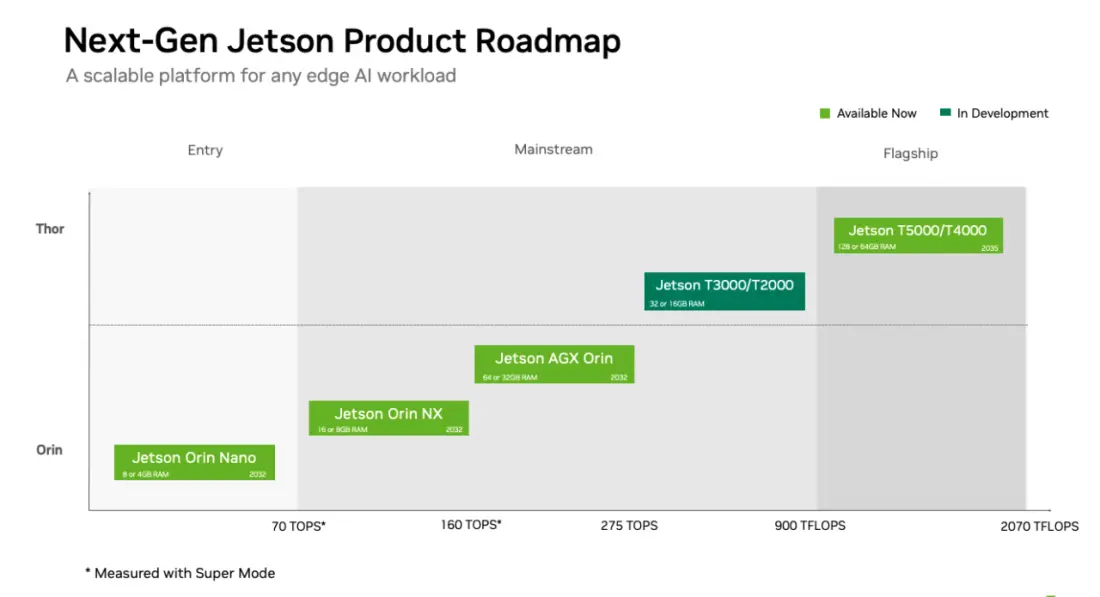
The more powerful option is the Jetson T3000. NVIDIA says it delivers up to 865 FP4 teraflops of AI compute in a compact module roughly half the size and power of the higher-end T5000.
The module combines an NVIDIA Blackwell GPU with an eight-core Neoverse Arm CPU, 32GB of LPDDR5X memory, 273GB/s of memory bandwidth and 25 GbE networking. NVIDIA says it can offer inference performance similar to the T5000 for multimodal workloads, including large language models, vision-language models, vision-language-action models and world foundation models.
The Jetson T2000 is aimed at a broader range of edge systems. It offers 400 FP4 teraflops and 16GB of memory, positioning it for visual AI agents, autonomous mobile robots, industrial manipulators and other intelligent machines where cost and power limits matter more.
Why local inference matters in robotics
Robots cannot always depend on a reliable round trip to a cloud data center. A machine moving around a warehouse or working near people needs fast responses even when connectivity is limited.
Running inference on-device can reduce latency and keep sensitive operational data closer to the machine. It also gives developers a way to combine multiple real-time inputs, such as cameras, lidar, force sensors and spoken instructions, without treating the cloud as a required control loop.
Jetson agent skills target memory constraints
NVIDIA also announced new Jetson agent skills intended to automate parts of memory optimization, system configuration and deployment. The company says these tools can help developers reduce memory use across the Jetson portfolio, including Jetson Thor and Jetson Orin.
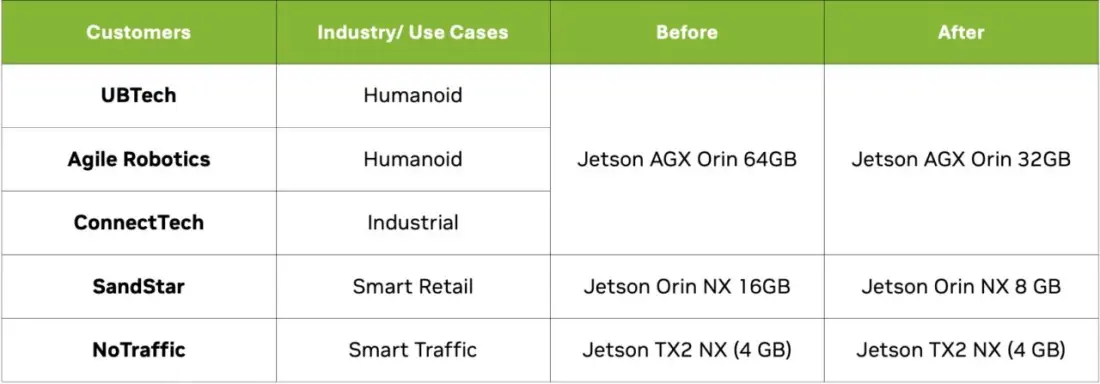
That is a practical issue for edge AI. Memory capacity often determines which model a robot can run and how much room remains for perception, planning and application software. NVIDIA cites examples of customers reducing memory use enough to move to a lower-memory Jetson configuration, although those results should be read as vendor-provided examples rather than universal benchmarks.
Cosmos 3 Edge arrives for Thor platforms
The launch also expands the Cosmos 3 model family with Cosmos 3 Edge, a 4-billion-parameter world foundation model designed for embodied systems. NVIDIA says the model can help a machine interpret its surroundings, reason in real time and predict or generate actions through on-device inference.
Developers can post-train Cosmos 3 Edge for particular sensors and robot designs, then deploy it on Jetson Thor for vision analysis and robot policies. The goal is to shorten the gap between simulation and real-world deployment.
Availability and development timeline
Developers do not need to wait for the final modules to begin software work. NVIDIA says the existing Jetson AGX Thor developer kit can emulate the new products because the Thor family shares the same chip architecture and software stack.
T3000 emulation mode is planned for JetPack 7.2.1 later this month, while T2000 emulation support will arrive later. NVIDIA expects the Jetson T3000 and T2000 modules to become available in Q1 2027.
Why this matters
NVIDIA is building a wider performance range for edge AI, from smaller Jetson devices to high-performance Thor systems. That matters for robotics companies because they can develop around a common software stack while choosing hardware that fits the cost, power and compute needs of each product.
The real test will be deployment. Hardware specifications are only one part of a usable robotics platform; developers also need reliable software, safety systems and tools that shorten the path from a demo to a machine working in the real world.
Our take
The T3000 and T2000 are not simply smaller AI servers. They are part of NVIDIA's effort to make multimodal and agentic AI practical in physical machines.
The T3000 looks particularly relevant for teams that need strong local inference but cannot justify the size or power budget of the T5000. The T2000, meanwhile, could make Thor accessible to more cost-sensitive robotics and industrial deployments. With availability still planned for 2027, the next important question is how well developers can translate the platform's headline compute into dependable real-world robot behavior.
Frequently asked questions
What are NVIDIA Jetson T3000 and T2000?
They are new NVIDIA Thor-based computing modules for robotics and edge AI. The T3000 is the higher-performance model, while the T2000 is designed for a broader range of lower-cost and lower-power deployments.
How much AI performance does the Jetson T3000 provide?
NVIDIA rates the T3000 at up to 865 FP4 teraflops. It includes a Blackwell GPU, an eight-core Arm CPU, 32GB of LPDDR5X memory and 25 GbE connectivity.
When will the new Jetson Thor modules be available?
NVIDIA expects the T3000 and T2000 modules to become available in Q1 2027. Developers can start software development earlier through emulation on the Jetson AGX Thor developer kit.
What is Cosmos 3 Edge?
Cosmos 3 Edge is NVIDIA's 4-billion-parameter world foundation model for embodied systems. It is intended to support on-device perception, reasoning and action generation for robots and other physical AI systems.