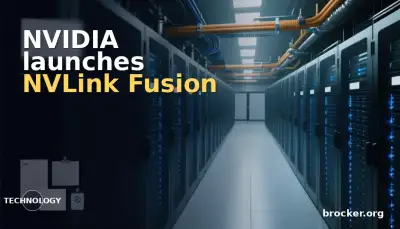
On August 24, 2026, NVIDIA announced NVLink Fusion, a program that lets hyperscalers and AI‑native companies plug their own custom accelerators — called XPUs — directly into NVIDIA’s proven AI factory stack. The goal is to let silicon teams focus on their differentiated compute while reusing NVIDIA’s scale‑up networking, rack architecture, power delivery, cooling, and software rather than building every layer from scratch.
NVLink Fusion connects third‑party XPUs to sixth‑generation NVLink, which spans a 72‑XPU domain with end‑to‑end latency 3× lower and packet rate 10× higher than off‑the‑shelf Ethernet alternatives. The program also includes NVLink‑C2C for attaching XPUs to NVIDIA Vera CPUs or other ecosystem CPUs at up to 6× the energy efficiency of a PCIe interface. Future NVLink roadmap configurations target domains of up to 1,152 accelerators with co‑packaged optics.
What's new
- Scale‑up fabric: 72‑XPU NVLink domain; 3× lower latency and 10× higher packet rate vs. commodity Ethernet.
- CPU attach: NVLink‑C2C delivers up to 6× better energy efficiency than PCIe for XPU‑to‑CPU links.
- Rack compatibility: XPU and GPU systems (e.g., Vera Rubin NVL72) share the same MGX rack footprint, liquid‑cooling loops, power distribution, and management plane.
- Ecosystem partners: ASIC design, CPU, IP, and optical interconnect vendors including Intel, MediaTek, GUC, Annapurna Labs (Amazon), and QCT/Quanta Computer.
- Software stack: NCCL for distributed workloads, Dynamo and NIXL for disaggregation, Mission Control for cluster management and telemetry.
- Reference architecture: Aligns with NVIDIA DSX blueprint and Omniverse DSX AI Factory digital twin for gigawatt‑scale facility codesign.
Why it matters
Custom silicon programs typically stall on the non‑differentiated plumbing: high‑speed SerDes integration, rack‑level cooling and power validation, multi‑vendor supply‑chain coordination, and cluster‑management software. NVLink Fusion moves those solved problems onto NVIDIA’s side of the ledger, letting XPU teams tape out and ship faster while still landing in a rack that operators already know how to deploy and service. The shared MGX footprint also means a data center can start with NVIDIA GPUs and later reprovision the same racks for custom XPUs as workloads, supply, or business priorities shift.
Our take
NVLink Fusion is less a new interconnect than a business‑model bridge: it turns NVIDIA’s full‑stack AI factory into a platform that monetizes the rack, the network, and the software even when the accelerator comes from a rival. The real test will be whether the NVLink‑C2C and NVLink Switch licensing terms, firmware integration timelines, and thermal envelopes are open enough for a MediaTek or an Annapurna Labs to hit volume without NVIDIA‑specific engineering bottlenecks.