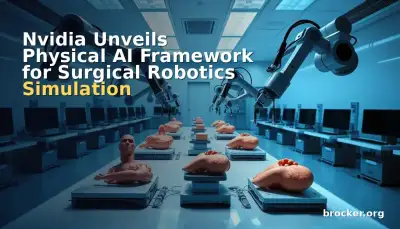
Nvidia has introduced a Medical Physics Simulation framework that treats healthcare robots as physical AI systems requiring embodied experience rather than code alone. The open-source addition to the Isaac for Healthcare platform combines classical physics simulation with generative AI to generate the physical interactions a surgical or diagnostic robot would otherwise need years of clinical exposure to encounter.
The framework addresses a core data problem in healthcare robotics: physical bodies operating in real procedures are scarce, tightly regulated, and slow to generate the range of scenarios a robot needs to master. By manufacturing embodied experience computationally, Nvidia aims to accelerate the pre-hardware development phase for surgical and diagnostic robots.
What's New
- Framework name: Medical Physics Simulation, an open-source component of Nvidia's Isaac for Healthcare platform.
- Simulation architecture: Classical physics simulation handles mechanical rules (catheter bending, vessel wall resistance, contact forces) while generative AI handles visual scene dynamics through a component called Cosmos-H Dreams.
- Compute stack: Nvidia's Warp and Newton libraries enable GPU-accelerated, differentiable physics and massive parallel environment execution.
- Benchmark result: A test running 8,192 parallel environments reduced training time from over five hours to under two minutes, demonstrating throughput for policy exploration.
- Data contributions: CMR Surgical contributed approximately 500 hours of anonymized clinical data from its Versius Surgical Robotic System to the Open-H Embodiment dataset, spanning cholecystectomy, prostatectomy, hernia repair, and hysterectomy procedures.
- Early adopters: Six named partners—CMR Surgical, Cambridge Consultants (Capgemini), Johnson & Johnson MedTech, XCath, Inner Logic, and Medtronic Structural Heart—are applying the framework at varying depths.
The framework's dual approach mirrors the physical AI proposition in miniature. Classical simulation gives a robot policy the physics it must obey; generative simulation gives it the range of visual and anatomical variation it needs to generalize. Running at scale on Warp and Newton, the system executes large numbers of parallel training environments instead of one scene at a time. Nvidia emphasizes that the benchmark demonstrates throughput, not clinical reliability, and says nothing about performance against incomplete imaging, delayed sensor readings, or anatomy outside the simulation's model.
CMR Surgical and Cambridge Consultants have gone furthest on the data side. CMR's 500-hour contribution to the Open-H Embodiment dataset provides a substantial foundation for shared learning. The pair are using Cosmos-H Dreams to model soft-tissue interaction physics and produce patient-specific simulations. Johnson & Johnson MedTech is building a digital twin of its endoluminal MONARCH platform focused on kidney-stone scenarios in urology, using a Cosmos-based foundation model alongside the framework. XCath applies the system to endovascular autonomy policy training, teaching navigation of blood vessels without human-in-the-loop control. Inner Logic generates synthetic data to validate device mechanics and intends to produce in silico evidence for regulatory submissions, though no such submission has been publicly confirmed. Medtronic Structural Heart sits earliest in the group, exploring simulated X-ray sensing for catheter navigation research. Each engagement remains a training exercise or dataset contribution; none is a deployed system operating on patients with policies learned this way.
Why It Matters
Healthcare robotics carries a governance requirement that most physical AI applications do not face to the same degree: regulators and clinical review boards need to see how a system arrived at its behavior, not just confirm that the behavior looked acceptable in testing. An open-source framework lets developers inspect the physics assumptions inside the simulation, reproduce results across different anatomies, and build an evidence trail suited to a submission before the FDA or an equivalent body. That is a stronger argument for openness in physical AI than in most software categories, where a closed vendor pipeline hides the assumptions a team would otherwise need to defend to a regulator.
The parallel-simulation approach represents a real advance in how fast developers can explore failure modes. A language model that underperforms on an edge case produces a bad answer; a physical AI system that underperforms on an edge case is operating inside a patient. Whether simulated failure modes match what actually goes wrong in a surgical suite remains a separate question. The framework could shorten the pre-hardware phase of physical AI development for surgical and diagnostic robots, and running training at this scale in parallel departs from rebuilding a custom simulation scene for every workflow.
Simulation throughput emerges as a potential moat: Nvidia's Newton/Warp stack turns simulation scale into a differentiable compute advantage, potentially locking surgical robotics developers into the Nvidia ecosystem. The open-source strategy doubles as a regulatory play—by open-sourcing the simulation and physics stack, Nvidia addresses the FDA/EMA demand for algorithmic transparency, creating a de facto standard for evidence generation. The data consortium flywheel seeded by CMR's 500-hour contribution grows in value as more partners add procedures, anatomies, and sensor modalities. Pre-hardware development compression could shrink the pre-clinical iteration loop from months to weeks, accelerating time-to-first-in-human for new robotic platforms. Ultimately, the embodiment gap remains the decisive moat: winners will be teams that close the sim-to-real gap through domain randomization, sensor noise modeling, and tissue property calibration, and publish peer-reviewed validation—not just those with the fastest simulators.
Our Take
Nvidia has delivered a genuine infrastructure advance: turning surgical simulation from a bespoke, scene-by-scene craft into a massively parallel, differentiable compute workload. The 8,192-environment benchmark is a credible throughput milestone. The open-source governance argument is strategically sharp—regulators increasingly demand model cards, data sheets, and reproducible simulation evidence, and an open stack is the most credible way to supply them.
However, the critical gap identified in the source material remains: throughput does not equal validity. Parallel simulation explores more failure modes faster, but only if the simulated failure modes are representative. No partner has yet published a sim-to-real transfer study showing that policies trained in Cosmos-H Dreams and Warp generalize to live tissue with noisy sensors and anatomical outliers. Until that evidence appears in peer-reviewed literature or regulatory filings, the framework is a powerful pre-clinical accelerator, not a deployment-ready solution.
The consortium model—CMR Surgical, Cambridge Consultants, Johnson & Johnson MedTech, XCath, Inner Logic, and Medtronic Structural Heart—is the right structure to generate the multi-institutional, multi-anatomy validation corpus that no single company can afford. Key signals to watch include the first peer-reviewed sim-to-real transfer paper from this consortium, the first FDA pre-submission citing Open-H Embodiment synthetic data as primary evidence, and adoption of Warp/Newton APIs by a surgical robotics OEM outside the announced consortium.
FAQ
What is Nvidia's Medical Physics Simulation framework?
It is an open-source addition to the Isaac for Healthcare platform that combines classical physics simulation with generative AI (Cosmos-H Dreams) to create embodied training environments for surgical and diagnostic robots. The framework runs on Nvidia's Warp and Newton libraries, enabling massively parallel simulation of physical interactions such as guidewire-vessel contact, soft-tissue response, and anatomical variations.
How does the parallel simulation benchmark work?
Nvidia reports a benchmark where 8,192 parallel training environments reduced a policy training run from over five hours to under two minutes. This demonstrates compute throughput for exploring failure modes at scale, but the company explicitly states it does not demonstrate clinical reliability or performance against incomplete imaging, delayed sensors, or out-of-distribution anatomy.
Which companies are using the framework and for what?
Six early adopters are named: CMR Surgical and Cambridge Consultants are modeling soft-tissue physics and patient-specific simulations using 500 hours of anonymized Versius data contributed to the Open-H Embodiment dataset. Johnson & Johnson MedTech is building a digital twin of its MONARCH platform for kidney-stone scenarios. XCath trains endovascular autonomy policies. Inner Logic generates synthetic data for device mechanics validation and intends to submit in silico evidence to regulators. Medtronic Structural Heart explores simulated X-ray sensing for catheter navigation research.
Why is the framework open source?
Healthcare robotics faces stricter governance than industrial robotics: regulators require transparency into how a system arrived at its behavior. Open code allows inspection of physics assumptions, reproduction of results across anatomies, and creation of an evidence trail for FDA or equivalent submissions. This addresses a regulatory requirement that closed vendor pipelines cannot easily satisfy.
Are any systems deployed on patients using this framework?
No. All six named partners are in training, data-contribution, or digital-twin phases. Nvidia does not claim any deployed system operates on patients with policies trained via this framework. The sim-to-real gap remains unvalidated by public peer-reviewed studies or regulatory filings.