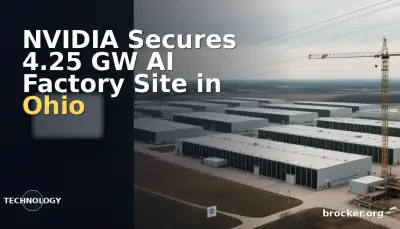
NVIDIA announced a 20-year commitment to secure land, power, and shell capacity at the PORTS-Pike Technology Campus in Portsmouth, Ohio. The move marks a strategic expansion of its AI factory infrastructure model.
OpenAI will be the anchor tenant. It will build and operate the facility using NVIDIA's full-stack DSX AI factory platform — GPUs, CPUs, networking, and infrastructure software. The initial deployment targets 4.25 gigawatts of AI factory capacity.
Later the same day, OpenAI published its own account of the deal. The company said it agreed to secure roughly 8 gigawatts of IT capacity at PORTS-Pike under a 20-year lease with SB Energy, which will build, own, and operate the campus while OpenAI pays only as completed capacity becomes available. OpenAI framed the project as a Pike County partnership: SB Energy will fund grid upgrades without shifting costs to Ohio ratepayers, the site will use closed-loop cooling to limit ongoing water demand, and combined community benefits exceed $160 million when SB Energy's existing grant commitments and OpenAI's additional pledges are counted together.
What's New
- Site: PORTS-Pike Technology Campus, Portsmouth, Ohio, in partnership with SB Energy
- Capacity: 4.25 GW initial (up to 8 GW total site capacity)
- OpenAI agreement: Customer commitment for ~8 GW-IT; lease payments begin as delivered capacity comes online
- Tenant: OpenAI will build and operate the AI factory
- Platform: NVIDIA DSX AI factory full stack (GPUs, CPUs, networking, software)
- Term: 20-year land-power-shell (LPS) commitment, phased activation 2028–2030
- NVIDIA investment: $1.5 billion equity in SB Energy, plus LPS credit support on the initial 4.25 GW buildout
- Jobs / phasing: ~35,000 construction jobs through a six-year buildout to 2032 and ~2,500 long-term operating roles; first ~800 MW expected in 2028 largely on existing AEP infrastructure
- Community: OpenAI adding $40 million to SB Energy's $40 million Pike County community fund
- Revenue scope: ~$600 billion in NVIDIA compute through 2030 across ~12–16 GW of OpenAI commitments
Each generation of NVIDIA systems at the site represents approximately 1.5 million GPUs. That translates to $150 billion to $200 billion in NVIDIA revenue per generation. Over two decades, the campus can support multiple upgrade cycles. NVIDIA may extend the arrangement to capture the remaining 3.75 gigawatts of site capacity.
NVIDIA's guarantee covers defined portions of lease and power payments plus a specified residual-value commitment. It does not cover the full site cost or all tenant obligations. Exposure declines as OpenAI makes lease payments and capacity comes online.
The company framed the move as supply-chain discipline applied to a new critical resource. LPS has become the binding constraint for frontier AI labs. These labs have strong revenue growth but lack the investment-grade credit profiles and decades-long infrastructure contracts that hyperscalers use to secure sites independently.
Why It Matters
The PORTS-Pike deal reframes AI infrastructure economics. By securing the long-lived physical foundation separately from the compute that fills it, NVIDIA creates an asset that can be upgraded across multiple hardware generations. Each new system generation delivers more intelligence per watt and better economics. The site itself remains productive for 20 years.
OpenAI's post adds a local-development lens: tens of thousands of construction jobs, explicit grid-cost isolation from ratepayers, and annual public reporting on hiring, water use, and energy. NVIDIA and OpenAI also plan a joint technical white paper on resilient data-center design at cluster scale.
If OpenAI's needs change, NVIDIA notes its compute is versatile and broadly adopted across a global ecosystem of cloud providers, enterprises, and AI labs. CUDA provides the common platform that makes redeployment practical. This model differs from the hyperscaler norm where Microsoft, Google, and Amazon secure their own LPS.
Our Take
NVIDIA is monetizing its demand visibility. It knows OpenAI's roadmap well enough to underwrite a 20-year physical plant, converting that certainty into a recurring revenue stream spanning multiple GPU generations. The residual-value commitment and phased exposure reduction suggest structured finance more than pure capital expenditure. OpenAI's follow-up post does not change that read — it confirms OpenAI as the paying customer while adding community and jobs politics that will matter in Ohio permitting and headlines. What remains unproven is whether the 4.25 GW initial phase reaches full utilization on schedule. The fungibility argument assumes a liquid secondary market for turnkey AI factory capacity that does not yet exist at this scale.