OpenAI announced Tuesday that an internal AI system has produced what it calls a proof resolving the Navier–Stokes existence and smoothness problem, one of the seven Clay Mathematics Institute Millennium Prize Problems. The proof shows that the three-dimensional Navier–Stokes equations for an incompressible fluid can develop a singularity — velocities growing without bound in finite time — even when starting from smooth initial data and a smooth external force with finite energy.
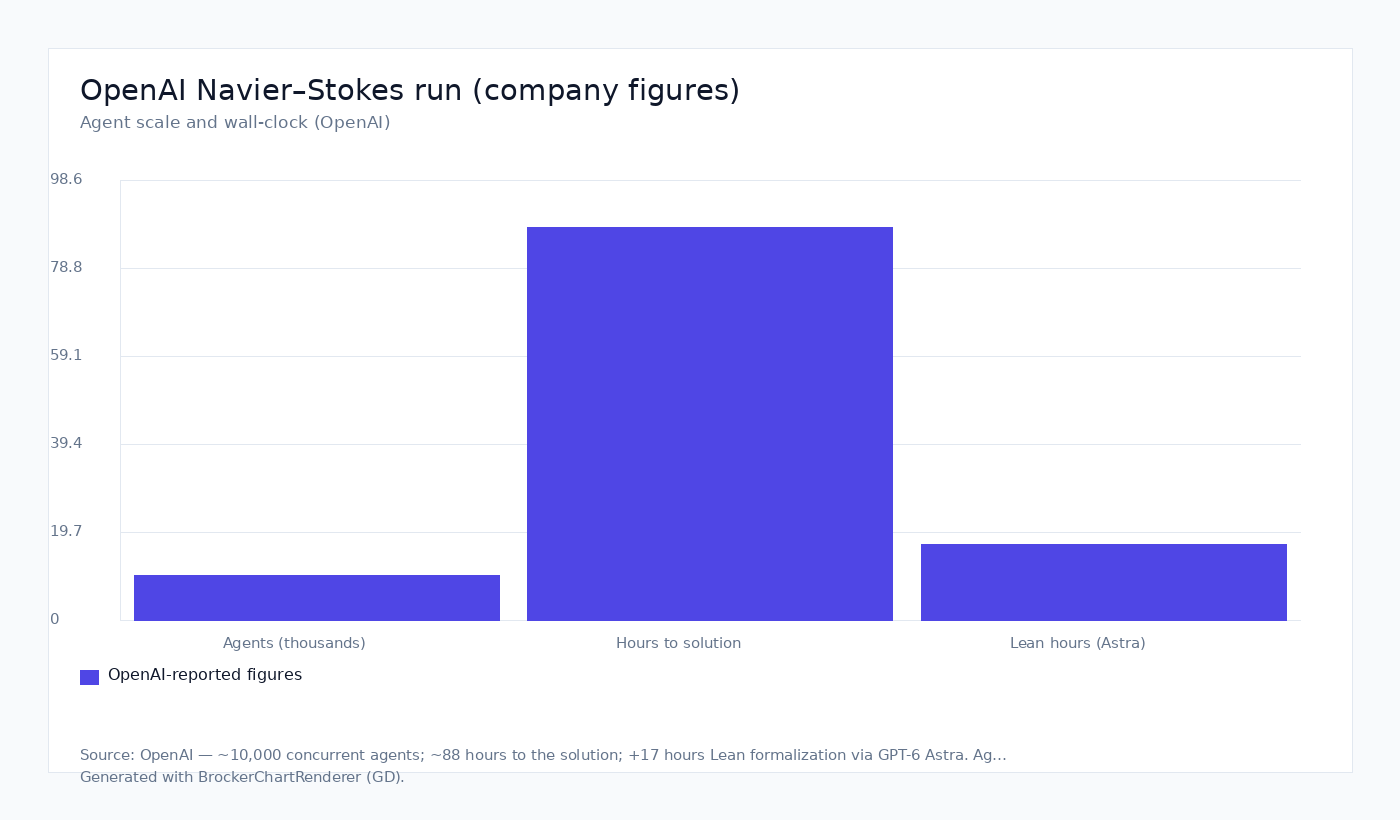
The result was generated by a model OpenAI describes as "significantly more capable than GPT‑6 Astra," running a multi-agent system of roughly 10,000 concurrent agents that exchanged 2.7 million messages and consumed about 130 billion output tokens over 88 hours. A Lean formalization of the proof was completed in an additional 17 hours using GPT‑6 Astra. OpenAI says it does not intend to claim the $1 million Millennium Prize, framing the disclosure as evidence of accelerating AI capability.
Confirmed
- OpenAI published a write-up and Lean formalization at openai.com/index/navier-stokes-solution/ on 8 September 2026.
- The proof establishes statement "C" (and also "D") in the official Millennium Prize formulation: a smooth solution can blow up in finite time.
- The construction is a vortex that spirals inward, stretches axially, and accelerates while total energy remains finite.
- Effort timeline: rumors heard 1 September; agents launched; solution found 5 September; Lean verification completed 6 September.
- OpenAI states its researchers and agents did not see the concurrent work of NYU mathematician Tristan Buckmaster and Anthropic researcher Levent Alpöge before public release.
Unknown
- Independent mathematical verification of the proof and Lean formalization by the Clay Mathematics Institute or external experts.
- Whether the proof meets the Millennium Prize criteria for award (the Institute has not commented).
- Full details of the internal model architecture, training data, or whether it will be released.
- Whether the concurrent Buckmaster–Alpöge work on forced Euler equations overlaps in a way that affects priority or novelty.
- Generalizability of the multi-agent approach to other Millennium Problems or open research questions.
Our take
The disclosure is as much a capabilities signal as a mathematical claim. Publishing the Lean formalization invites formal verification — a prudent move given the stakes. The credit dispute with Buckmaster and Alpöge underscores a growing tension: frontier labs running massive agent swarms on open problems may traverse research directions that human mathematicians are pursuing privately. Until the Clay Institute or independent experts validate the proof, the result remains a remarkable internal benchmark, not a settled prize.