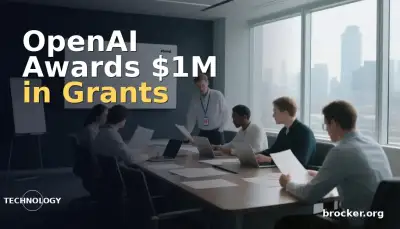
OpenAI has selected 14 independent organizations for policy research grants tied to its Industrial Policy for the Intelligence Age framework, published in April 2026. Per OpenAI's announcement, the company will provide $1 million in direct funding and up to $1 million in API credits across projects spanning the United States, European Union, Brazil, Singapore, and South Korea — the grant awards name the recipients; disbursement follows the six-month project window.
The grants follow a call for proposals that drew more than 400 responses. Selected projects address two broad questions: how AI can broaden economic opportunity and how societies can build resilience as capabilities advance. Work will run for six months, with results expected in 2027.
What's new
- Funding (committed, not yet disbursed): $1 million in grants plus up to $1 million in API credits — OpenAI says it will provide this across selected projects
- Timeline: Six-month project duration, results reported in 2027
- Geographic spread: U.S., EU, Brazil, Singapore, South Korea
- Selection: 14 projects chosen from 400+ applicants
- Economic opportunity cohort (7 projects): Includes AEI employment-disruption scenarios, CEPS on productivity distribution in Europe, ECipe on a "Right to AI" framework, PPI on portable benefits and livelihood insurance, Tax Foundation on AI-era tax shifts, plus Brazil-based IMPA (research access) and USP Hospital das Clínicas (SUS clinical AI pilot)
- Resilience cohort (7 projects): Includes IST on recursively self-improving AI measurement, Nuclear Threat Initiative on AI-bio information sharing, Council on Strategic Risks on frontier-AI safety capacity, NTU on privacy-preserving policy simulation, and Yonsei on legislative oversight quality in South Korea
- Full project list: OpenAI's announcement names every grantee and scope — linked in Sources
Why it matters
OpenAI's 2026 policy framework argued that incremental policy updates won't suffice for a transition toward superintelligence, calling for governments to use the full policy toolbox — from research funding and workforce development to market-shaping tools and targeted regulation. These grants widen the circle of institutions developing evidence for that toolbox, moving beyond company-led proposals to independent research that democratic societies can adapt to their own circumstances.
The projects collectively probe whether concepts like a "Right to AI," person-based portable benefits, livelihood insurance, and international AI-bio information sharing can be operationalized. Results will inform whether such ideas merit legislative attention or remain theoretical.
Our take
The grant program is a notable shift from publishing policy positions to funding independent stress-tests of those positions. Whether the six-month timeline yields implementable frameworks or primarily academic exercises will determine if this model becomes a template for other frontier labs.