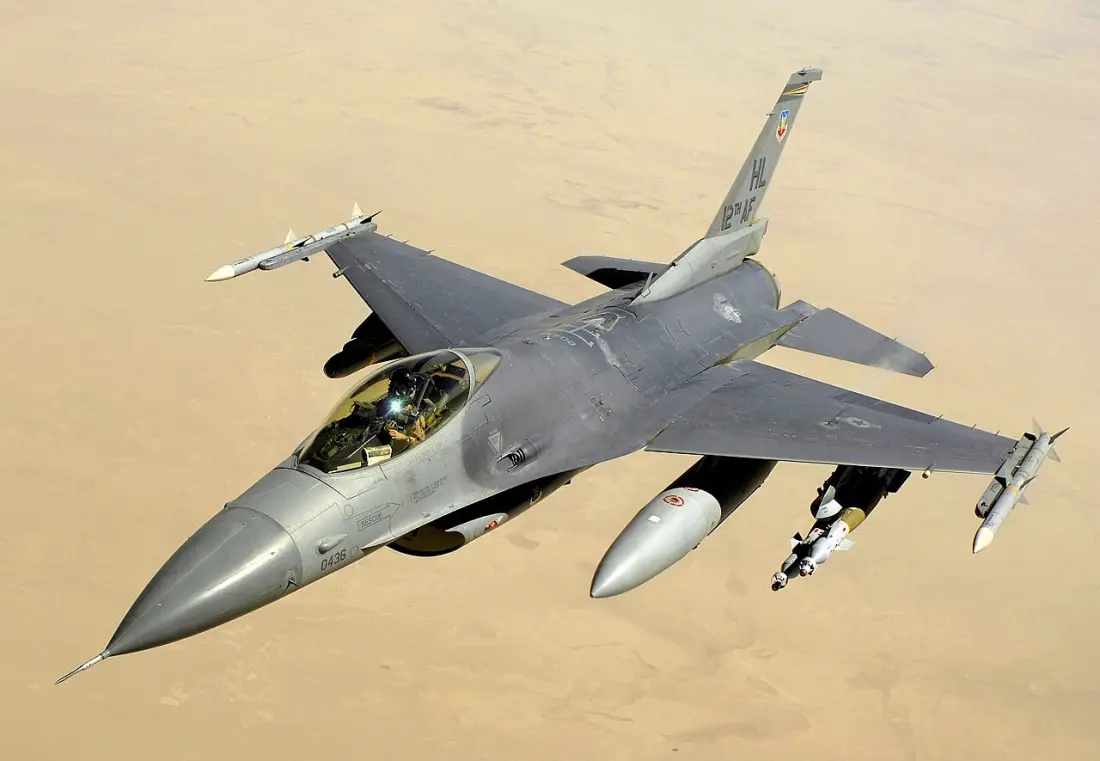
The U.S. Defense Advanced Research Projects Agency (DARPA) and the U.S. Air Force have successfully flown a modernized F-16 fighter jet controlled by artificial intelligence. The test marks a significant milestone in the integration of autonomous capabilities into existing military aircraft, demonstrating that older platforms can be retrofitted with advanced AI systems without requiring a complete redesign.
While a safety pilot remained in the cockpit throughout the flight, control of the aircraft was handed over to the AI after reaching a safe altitude. The pilot monitored the system and stood ready to take over if needed, following a "human-on-the-loop" oversight model. This approach allows the AI to make rapid decisions while a human supervisor retains the ability to intervene in case of anomalies or unexpected situations.
The flight took place under DARPA's VENOM (Versatile, Expendable, Non-recoverable, Operationally Mobile) program, which aims to develop and test autonomous capabilities for existing fighter jets. The test vehicle was a modernized F-16, chosen because it represents a widely used platform that could benefit from autonomy upgrades. The success of this flight opens the door to retrofitting hundreds of F-16s in the U.S. and allied inventories with similar capabilities.
What's New: VENOM Autonomy Kit
The core of the test was the VENOM Autonomy Kit, a system that adds an AI pilot to the aircraft without altering its core flight software. This is a key differentiator from previous autonomous flight demonstrations, which often required extensive modifications to the aircraft's avionics and control systems. The VENOM kit is designed to be a modular add-on that can be installed on existing F-16s with minimal downtime and cost.
- The VENOM kit controls flight, sensors, and mission systems, effectively acting as a co-pilot or full pilot depending on the mode.
- It can be retrofitted into existing F-16s without extensive software changes, preserving the aircraft's original safety-critical code.
- This was the first demonstration of an older-generation F-16 converted to autonomous flight using a retrofit kit.
- Previous tests used the X-62A VISTA platform, a specialized testbed that was designed from the ground up for experimental autonomy work.
- The system supports multiple AI agents that can be swapped or updated, allowing rapid iteration of tactics and behaviors.
DARPA stated that the VENOM kit enables multiple converted F-16s to test different AI agents and air combat tactics simultaneously. This is a significant departure from traditional flight testing, where each sortie is carefully scripted. With VENOM, multiple aircraft can fly in coordinated patterns, each running a different AI algorithm, and the results can be compared in real time. The system also allows evaluation of cooperation between AI agents, responses to air and electronic warfare threats, and coordination between manned and unmanned aircraft.
The kit includes hardware and software components that interface with the aircraft's existing data buses and control surfaces. It can be installed in a matter of days, according to DARPA officials, and does not require the aircraft to be taken out of service for extended periods. This is critical for military units that need to maintain high readiness rates while incorporating new technology.
Why It Matters
The ability to retrofit older F-16s with autonomous capabilities could extend the lifespan of existing fleets and reduce the need for costly new aircraft. The U.S. Air Force operates hundreds of F-16s, many of which are decades old but still structurally sound. Adding AI piloting capability could allow these aircraft to perform missions that would otherwise require newer, more expensive platforms, such as the F-35 or the upcoming Next Generation Air Dominance (NGAD) fighter.
DARPA envisions future operations where human pilots manage multiple autonomous aircraft, especially in beyond-visual-range (BVR) missions. In this concept, a single human pilot in a command aircraft could direct a swarm of AI-controlled F-16s, each executing different tactics and engaging targets autonomously. This approach could reduce pilot risk by keeping humans out of the most dangerous environments, while also improving reaction times and attack range. AI-controlled aircraft can process sensor data and make decisions faster than humans, which is critical in high-speed air combat.
The VENOM program also serves as a building block for DARPA's Artificial Intelligence Reinforcements (AIR) program, which aims to create autonomous fighter squadrons. AIR is focused on developing the algorithms and training methods needed for AI agents to operate effectively in complex, contested environments. The data collected from VENOM flights will feed directly into AIR, accelerating the development of more capable and reliable AI pilots.
From a geopolitical perspective, the ability to rapidly field autonomous combat aircraft could shift the balance of power in regions where the U.S. and its allies face numerically superior forces. By augmenting human pilots with AI-controlled wingmen, the U.S. Air Force could achieve greater combat effectiveness without increasing the number of pilots or aircraft. This is particularly relevant in the Indo-Pacific theater, where distance and reaction time are critical factors.
However, the technology also raises questions about the ethics of autonomous weapons and the potential for unintended escalation. DARPA has emphasized that the human-on-the-loop model ensures accountability, but critics argue that even with human oversight, the speed of AI decision-making could lead to situations where humans are unable to meaningfully intervene. The Pentagon has stated that it will maintain human control over lethal decisions, but the line between autonomous and semi-autonomous systems is blurring.
Our Take
This test demonstrates that autonomous flight technology is maturing rapidly, but it also highlights the careful approach taken by the military. The human-on-the-loop model is a pragmatic compromise that allows the benefits of AI speed and consistency while retaining human judgment for critical decisions. Retrofitting existing aircraft is a smart strategy that could accelerate adoption without waiting for next-generation platforms, which are years away from operational service.
We are particularly impressed by the modularity of the VENOM kit. By not requiring changes to the core flight software, DARPA has addressed one of the biggest barriers to fielding autonomy on legacy aircraft: the risk of introducing bugs into safety-critical systems. This approach could serve as a template for other military platforms, including bombers, tankers, and even naval vessels.
That said, challenges remain. The AI's performance in contested environments with heavy electronic warfare and decoys has not been tested. The current test was conducted in a controlled airspace with no adversaries. Real-world combat will present unpredictable scenarios that may confuse even the most advanced AI. Additionally, the trust factor cannot be overlooked. Human pilots will need extensive training to work alongside AI wingmen, and the military will need to establish new doctrines for human-machine teaming.
Finally, the ethical dimension cannot be ignored. While DARPA has been transparent about its human-on-the-loop approach, the speed of future engagements may force a shift to more autonomous decision-making. The international community is still debating rules for lethal autonomous weapons, and the U.S. has not yet committed to a binding treaty. As these systems move closer to operational use, the debate will only intensify.
Overall, the VENOM test is a clear step forward, but it is just one step on a long road. The technology is promising, but the path to fully autonomous combat aircraft is still measured in years, not months. For now, the human pilot remains irreplaceable.
FAQ
What is the VENOM Autonomy Kit?
The VENOM Autonomy Kit is a system developed by DARPA that adds autonomous flight and mission control capabilities to existing F-16 aircraft without modifying their core flight software. It controls flight, sensors, and mission systems, and can be installed in days.
How does the human-on-the-loop model differ from human-in-the-loop?
In the human-on-the-loop model, a human operator monitors the AI system and can intervene if necessary, but does not approve every decision. In human-in-the-loop, every critical action requires human approval. The former allows faster AI-driven responses while maintaining oversight.
Was this the first time an AI flew an F-16?
Previous AI flights were conducted using the specialized X-62A VISTA testbed. This test was the first to retrofit an older F-16 with autonomous capabilities, showing the technology can be applied to existing aircraft without extensive modifications.
What are the long-term goals of the VENOM program?
DARPA aims to create autonomous fighter squadrons where human pilots manage multiple AI-controlled aircraft, particularly for beyond-visual-range missions. This could reduce pilot risk and improve combat effectiveness by leveraging AI speed and coordination.
Will the AI replace human pilots?
No, the goal is to augment human pilots, not replace them. The concept involves humans overseeing autonomous aircraft, allowing them to focus on higher-level strategy while AI handles routine or dangerous tasks. Human pilots will still be essential for command and ethical decision-making.