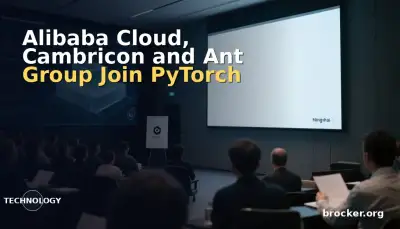
On September 8, 2026, the PyTorch Foundation announced that Alibaba Cloud and Cambricon have joined as Platinum members and Ant Group as a Gold member. The memberships were presented at the first PyTorch Conference China in Shanghai, co-located with KubeCon + CloudNativeCon + OpenInfra Summit China 2026 (September 7–9).
Huawei, already a long-standing Foundation supporter, shares the keynote stage. A shorter Cambricon Platinum post from the Foundation supplies the chip maker’s board and Technical Advisory Council seats; this article folds that detail into the Shanghai announcement rather than running a second membership story.
Confirmed
- Membership tiers: Alibaba Cloud and Cambricon — Platinum; Ant Group — Gold (PyTorch Foundation / Linux Foundation disclosure).
- Where it landed: Announced at PyTorch Conference China 2026 in Shanghai during the co-located CNCF / OpenInfra / PyTorch China event.
- Platinum seats: Platinum members receive one seat on the Governing Board and one on the Technical Advisory Council.
- Cambricon board / TAC names: Jin Wang (Senior Director of AI Frameworks and Infrastructure) takes the Governing Board seat; Jing Zhu (lead maintainer on Cambricon’s PyTorch work) joins the TAC.
- Cambricon upstream posture: The company describes an “Upstream First” record spanning torch.compile, Eager operators, device runtime, distributed training, AMP, DataLoader, and Profiler, plus Torch-MLU on PrivateUse1 and vLLM Day-0 enablement claims for models including DeepSeek-V4 and GLM-5 on its hardware.
- Keynote stack (Foundation agenda): Alibaba Cloud on serving Qwen at scale with Karmada; Huawei on Ascend and PyTorch; Cambricon on device-agnostic multi-backend infrastructure; Ant Group on agent needs from open infrastructure and building an agent runtime with Kubernetes Agent Sandbox and Kata Containers.
- China contributor base (Foundation figure): More than 250 organizations across China contribute to Foundation projects including DeepSpeed, Helion, PyTorch, Ray, Safetensors, and vLLM.
Unknown
- Shipping timelines: How fast Cambricon and Ascend device-agnostic work lands as default, release-trained PyTorch experiences — versus vendor extensions — is not dated in the membership posts.
- Governance weight: Board seats set policy scope; they do not by themselves guarantee merge velocity or backend parity with NVIDIA-first workflows.
- Separate NA track: PyTorch Conference North America 2026 (San Jose, October 20–21) is a different event; Core-track coverage remains on Brocker’s earlier North America sessions piece.
Why it matters
The Shanghai package is governance plus stagecraft: Chinese cloud (Alibaba / Qwen serving), accelerators (Cambricon MLU, Huawei Ascend), and agent runtime (Ant) are being steered into the same vendor-neutral Foundation that already hosts PyTorch, vLLM, and related serving/training projects. For multi-backend PyTorch, that is less a product launch than a commitment to argue hardware portability inside the same boardroom that sets Foundation direction.
Our take
Treat the Platinum/Gold labels as real seats, not shipping guarantees. The useful test is upstream: whether device-agnostic and Ascend/MLU work reduces forks, or whether “native experience” stays a keynote phrase. Brocker already covered the North America Core track separately — keep China membership and NA sessions as sibling angles, not one catch-all conference file.
Related: PyTorch Conference North America 2026 Core sessions.