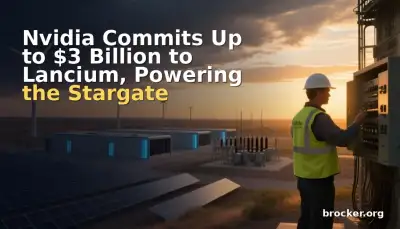
Nvidia has agreed to invest up to $3 billion in Lancium, the Texas-based power infrastructure developer behind the first operational site of the Stargate AI campus in Abilene. The deal, first reported by The Information and confirmed by Reuters, structures an initial $2 billion for a roughly 20% stake in the Blackstone-backed company, with a further $1 billion contingent on Lancium securing additional grid connections and hitting other milestones. The transaction values Lancium's portfolio of land and power assets at approximately $10 billion in enterprise value, including debt. Neither Nvidia nor Lancium has issued a public confirmation; the details come from people familiar with the transaction cited by The Information and Reuters.
The investment deepens Nvidia's move beyond chip supply into the physical layer of AI infrastructure — power, land, and data-center campuses — at a moment when electricity access has become the primary bottleneck for large-scale model training and inference. Lancium's 1,000-acre Clean Campus in Abilene already serves as the inaugural Stargate site, the joint venture among SoftBank, OpenAI, and Oracle that was unveiled in January 2025 with a headline commitment of up to $500 billion in U.S. AI infrastructure. Nvidia's capital is expected to accelerate Lancium's expansion and support a potential initial public offering as early as 2027. Nvidia shares closed at $223.96 on August 7, 2026, implying a market capitalization near $5 trillion, underscoring the chipmaker's capacity to fund strategic infrastructure bets without diluting its core semiconductor roadmap.
What's New / Specs
The agreement contains several concrete financial and operational terms that clarify how Nvidia's capital will be deployed and what conditions govern the follow-on tranche:
- Initial investment: $2 billion for approximately 20% equity in Lancium.
- Contingent tranche: Up to $1 billion additional, released when Lancium meets defined thresholds — principally securing new grid hookups and expanding power-delivery capacity.
- Enterprise valuation: ~$10 billion for Lancium's land bank, power contracts, and development pipeline, inclusive of the Nvidia investment and existing debt.
- Key asset: The 1,000-acre (404.7-hectare) Lancium Clean Campus in Abilene, Texas, already energized and operating as the first Stargate location.
- Strategic context: Stargate is a three-way venture among SoftBank, OpenAI, and Oracle, announced by President Donald Trump in January 2025 with a target of up to $500 billion in U.S. AI infrastructure spending over four years.
- Liquidity path: Lancium is exploring an IPO in 2027, which would provide an exit avenue for Nvidia and other shareholders.
- Market snapshot: Nvidia shares closed at $223.96 on August 7, 2026, implying a market capitalization near $5 trillion.
Blackstone's backing of Lancium predates this round and remains in place, providing the developer with a deep-pocketed sponsor experienced in large-scale energy infrastructure. The Information's reporting notes that the $2 billion would give Nvidia a roughly 20% stake, while the additional $1 billion is tied to "certain thresholds, including grid hookups," according to people familiar with the matter. Reuters, citing the same sources, adds that Nvidia and Lancium did not immediately respond to requests for comment, a standard practice for transactions that have not yet been formally announced.
Why It Matters
Power has replaced silicon as the scarcest resource in frontier AI development. While Nvidia's GPUs remain the compute engine of choice, the lead time for high-voltage grid interconnections, substation upgrades, and permitting now stretches years — often longer than the procurement cycle for the chips themselves. By taking a direct equity stake in a power-infrastructure developer, Nvidia gains contractual visibility and priority access to the very electrons its customers need to run the next generation of models. This move mirrors a broader industry trend: cloud hyperscalers and chipmakers alike are securing energy supply chains to de-risk their AI roadmaps.
The Stargate partnership amplifies the strategic weight of this move. SoftBank brings capital and telecom-scale project management; OpenAI brings workload demand and model-architecture insight; Oracle brings cloud-operations expertise and enterprise customer relationships. Nvidia's investment effectively locks the chipmaker into the anchor tenant's power supply chain, reducing the risk that a competitor secures the same capacity. It also signals to the market that Nvidia views infrastructure ownership — or at least deep financial integration with infrastructure owners — as a durable competitive moat, not a one-off project finance exercise.
For Lancium, the $2 billion infusion provides immediate dry powder to accelerate development of its Texas land bank, pursue additional sites, and negotiate utility upgrades from a position of strength. The contingent $1 billion creates a clear incentive structure tied to grid interconnection milestones, aligning the developer's execution risk with Nvidia's capital deployment. An IPO in 2027 would offer a liquidity event that validates the asset class and could attract a broader pool of institutional investors to AI-focused power infrastructure. The Business Times, summarizing the same Information report, notes that Lancium's Clean Campus spans 404.7 hectares and is already serving Stargate workloads, a rare example of a greenfield AI data-center campus with live power contracts.
Our Take
Nvidia's willingness to deploy billions into power infrastructure marks a maturation of its strategy from component supplier to ecosystem architect. The company has long argued that the total cost of ownership for AI factories is dominated by energy and cooling, not just silicon; this deal puts capital behind that thesis. However, the structure — a minority stake with performance-based tranches — suggests Nvidia wants influence without the operational burden of owning and operating substations or managing utility regulatory proceedings. This approach preserves focus on its core semiconductor and software stack while still capturing upside from the infrastructure layer.
The valuation of ~$10 billion enterprise value for Lancium's portfolio implies a significant premium for contracted, grid-connected acreage in ERCOT territory. Whether that premium holds depends on the pace of Stargate's build-out and the broader trajectory of AI compute demand. If OpenAI and Oracle scale their Abilene footprint as planned, the power assets could appreciate substantially. If demand softens or alternative architectures — such as more efficient inference chips or distributed training frameworks — reduce per-model energy intensity, the asset base may face repricing risk. Investors should watch two leading indicators: the speed at which Lancium converts the contingent $1 billion into secured grid interconnections, and the cadence of Stargate site announcements beyond Abilene. Both will signal whether this partnership is the template for a wave of chipmaker–infrastructure alliances or a bespoke arrangement tied to a single mega-project.
Finally, the deal underscores a shifting capital allocation priority across the AI stack. As model training clusters grow from tens of thousands to hundreds of thousands of GPUs, the marginal cost of compute increasingly reflects the cost of reliable, low-carbon power. Nvidia's investment can be read as a hedge: if the company can help shape where and how that power is delivered, it protects its own revenue trajectory while creating a new lever of influence over the geography of AI development.
FAQ
How much is Nvidia investing in Lancium and on what terms?
Nvidia will invest an initial $2 billion for roughly a 20% equity stake in Lancium. An additional $1 billion is contingent on Lancium meeting specific milestones, primarily securing new grid connections and expanding power-delivery capacity. The total potential commitment is $3 billion.
What is the Stargate project and who are the partners?
Stargate is a joint venture among SoftBank, OpenAI, and Oracle to build large-scale AI data-center infrastructure in the United States. Announced in January 2025 by President Donald Trump, the venture targets up to $500 billion in investment over four years. Lancium's Abilene campus is the first operational Stargate site.
Why is Nvidia investing in power infrastructure instead of just selling chips?
Electricity access and grid interconnection lead times have become the primary bottleneck for deploying AI compute at scale. By taking an equity stake in Lancium, Nvidia gains priority visibility into power capacity for its customers and integrates more deeply into the physical layer of AI factories, creating a competitive moat beyond silicon.
What is Lancium's Clean Campus in Abilene?
The Lancium Clean Campus is a 1,000-acre (404.7-hectare) site in Abilene, Texas, designed for high-density, clean-energy-powered data centers. It is already energized and serves as the inaugural operational location for the Stargate initiative.
When might Lancium go public?
Lancium is exploring a potential initial public offering in 2027, according to the reporting. The Nvidia investment and Stargate anchor tenancy are intended to strengthen its financial profile ahead of such a listing.
Series: 1. Nvidia Commits Up to $3 Billion to Lancium, Powering the Stargate AI Campus in Texas · 2. Nvidia Opens cuFile and Launches Storage-Next to Make SSDs a First-Class AI Memory Tier · 3. NVIDIA Secures 4.25 GW AI Factory Site in Ohio for OpenAI Through 20-Year LPS Commitment · 4. NVIDIA Serves Alibaba's Qwen3.8-2.4T-A95B on GB300 NVL72 With Day-0 FP8 Performance · 5. NVIDIA Shows How to Run Isolated Tenant Kubernetes Clusters on Shared GPU Infrastructure · 6. NVIDIA Vera BlueField-4 STX Benchmarks Show Up to 3.7x Faster Storage Primitives for AI-Native Workloads · 7. NVIDIA Publishes Full-Stack Observability Framework for AI Factories · 8. NVIDIA DSX MaxLPS Reclaims Stranded Power to Fit 40% More GPUs in Same Facility Envelope · 9. NVIDIA Invests in Cloverleaf Infrastructure to Accelerate AI Factory Buildout · 10. NVIDIA Vera Rubin NVL72 Delivers 30x Throughput-per-Watt Gain Over Blackwell on AgentX Benchmark · 11. NVIDIA Spectrum-X Ethernet rewrites the rules for giga-scale AI factories · 12. NVIDIA Introduces Scale-In as Fifth AI Networking Pillar with BlueField-4 DPU · 13. NVIDIA launches NVLink Fusion to connect custom XPUs to its AI factory infrastructure · 14. NVIDIA Demonstrates Qwen3.8-Flash-Next 176B on GB300 NVL72 for Agentic Coding · 15. NVIDIA NVLink Fusion Brings NVHBM to Next-Generation AI Infrastructure · 16. NVIDIA ships Vera CPU to Anthropic, OpenAI, Oracle, and SpaceXAI · NVIDIA AI Factory